give me a daisy

~ ~ ~ ~ read ~ write ~ look ~ listen ~ create

Archive for the month “September, 2012”

she changes: Janet Echelman’s lacenet

She Changes, 2005 – Porto, Portugal

Janet Echelman spent seven years as an Artist-in-Residence at Harvard. She left Harvard to go to India on a Fulbright lectureship with the intention of giving painting exhibitions around the country.

Although she arrived in Mahabalipuram, a fishing village in India, her paints did not. Without her paints, she needed to find another medium. First she tried working with bronze casters, but that was expensive and unwieldy. Then one night, she notice the fishnet the fishermen were bundling on the beaches, and that sparked her imagination.

She wondered “if nets could be a new approach to sculpture: a way to create volumetric form without heavy, solid material.” The works she’s created are ethereal and stunning, unlike anything I’ve seen before. I really want one!

but what if her paints HAD shown up?

Echelman was probably dismayed, to say the least, that her paints hadn’t made it to India. But she didn’t give up and go home. It didn’t stop her from doing what she’d come to India to do. She took the materials at hand and used them in a way they’d never been used before. Although she didn’t have her paints, she still had her imagination and her creative spirit.

Things hadn’t gone according to her plan. And it was a very good thing they didn’t because if they had, we wouldn’t have these gorgeous lacy sculptures to look at. It’s important to have a plan. But it’s equally important to not be so committed to the specifics of the plan that when things begin to fall apart, you fall apart, too.

she changes

Change. Adapt. Be flexible. Look around you. Create from what’s already there.

More views of the piece She Changes (above) can be seen on Echelman’s website, which also describes the materials used in this and other sculptures and their method of construction.

And you can listen to Echelman–and see slides of her work–in this TED talk called “Taking Imagination Seriously.”

arts & the mind

It’s more than sad and disappointing that so many elementary and secondary schools are decreasing art programs or cutting them out altogether. It’s a cost-saving measure that hurts not only the students, but also society in general. Arts–and creativity–are not add-ons or extras. They aren’t really dispensable.

Humans have been making art, in the form of painting, drawing, and carving, as well as music, since at least 20,000 BC–possibly even since 40,000 BC. Maybe it was engaging in those creative pursuits that contributed to our increased brain size and our unique capacity for learning and transforming the world we found ourselves in. How ironic is it then to get to this point only to collectively turn our backs on art?

your brain on jazz

Charles Limb is a surgeon and jazz musician. In this TED talk, he says:

Artistic creativity is a neurologic product that can be examined using rigorous scientific methods.

So he used fMRI (functional magnetic resonance imaging) on some jazz and rap musicians. Watch and listen to see what he found out.

And the man raps! (He claims it will never happen again.)

the neurological connections

Limb is featured in the recent two-part PBS series Arts & the Mind, hosted by Lisa Kudrow. It’s entertaining, moving, and informative. I highly recommend it. (The link takes you to a page where you can watch both episodes in their entirety.)

EPISODE ONE – Creativity

Arts & the Mind explores the vital role the arts play in human development throughout our lifetimes. Episode One, “Creativity,” features stories and the latest scientific research from experts around the country illuminating how the arts are critical in developing healthy young minds and maintaining them as we age. Showcases innovative arts education programs OrchKids in Baltimore and Get Lit in Los Angeles.

EPISODE TWO – The Art of Connection

This episode illuminates how art is the brain’s lifeline to empathy, emotion, mental agility and healing. Features stories and experts’ insights on: the positive effects of the arts for: children in hospitals; veterans suffering from Post-Traumatic Stress Disorder; building community in Appalachia; and warding off dementia.

final words

Science has to catch up to art.

–Charles Limb

life or fiction?

Which do you choose? The question is asked by Clay Hammond, one of the characters in the movie The Words. In this story, itself a story-within-a-story-within-a-story, Hammond, played by Dennis Quaid, is the author of a novel about another author, Rory Jenson. Jenson, played by Bradley Cooper, is a struggling writer who, after a trip to Paris with his wife, accidentally comes across the find of his life: an unpublished manuscript, the quality of which far surpasses that of his own multiply rejected efforts.

At a low point in his attempt to get his writing career off the ground, Jenson decides to type the entire manuscript into his computer, just so he can feel the words and experience what it might have been like to write something that good. He has no ulterior motive in doing so. This might not seem believable to everyone in the audience, but writing out or typing passages from the works of great writers is an exercise often recommended to aspiring ones.

After some prodding from his wife, however, Jenson agrees to submit the book to a publisher who naturally falls in love with it. The book is published to great acclaim, and Jenson receives several prestigious awards. As time passes and he’s able to get one or two other novels published, Jenson begins to forget that he didn’t actually write that first book. That’s when the true author of the manuscript, referred to in Hammond’s book as “the old man,” shows up and tells Jensen his story, the story the novel is based on. The old man is played by a grizzled, down-and-out Jeremy Irons.

So Jenson faces a conundrum: what to do now? He wants to make things right, but will he?

a loose weave

There’s a lot to try to tie together here to make everything work and make sense—on the one hand—while sustaining an element of mystery on the other. But the screenwriters either didn’t have or didn’t take enough time to do a seamless job of it. [David Mitchell tackles a much more complex interweaving of multiple storylines in his 500+ page novel The Cloud Atlas. Can’t wait to see the movie version, which will be out later this year. ] As a result, The Words has a few gaps, some of which I was dimly aware of as I watched the movie; others opened up the day after. They weren’t enough to turn me against the movie, but the screenwriters could easily have fixed them. So why didn’t they?

The collective gaps were minor compared to my main problem with the movie, which is the casting of Jeremy Irons in the role of “the old man.” His acting was impeccable, but he wasn’t remotely believable as the aging version of his younger self, a role well-acted by Ben Barnes. Irons bothered me so much that I couldn’t suspend disbelief during any of his scenes. My movie-going companion had the same complaint, but it didn’t bother her to the extent it did me.

The women in The Words all necessarily played supporting roles. I thought the best of the three was Nora Arnezeder as Celia, the young Parisian wife.
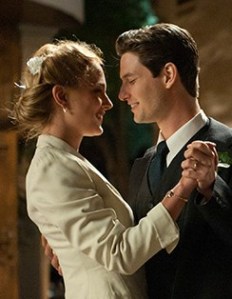
Nora Arnezeder & Ben Barnes

On the plus side, it was gratifying to see a writer portrayed so accurately onscreen. That doesn’t always happen in movies about writers or writing. While there are plenty of movies about writers, there are not as many about the process of writing a particular book. Some I’ve enjoyed are Finding Neverland, Capote, and Adaptation. My all-time favorite, though, is Stranger than Fiction, which is in my permanent collection. [Stranger boasts a righteously eclectic cast: Will Ferrell, Emma Thompson, Queen Latifah, Maggie Gyllenhal, and Dustin Hoffman. If you’ve been put off by the majority of Will Ferrell’s movies, give this one a chance. Watch it for the rest of the cast, but I’ll bet Ferrell will surprise you.]

Back to the question: life or fiction? The old man chose life. What did Jenson choose? And what did Clay Hammond choose?

The Words
Brian Klugman and Lee Sternthal, directors and screenwriters
Bradley Cooper, Dennis Quaid, Jeremy Irons, Ben Barnes, Zoe Saldana, Nora Arnezeder, and Olivia Wilde

I give it an A for effort and good intentions, an A- for acting, and a C+ for overall execution.

Have you seen it? What did you think? What are your favorite movies about writers and/or the writing life?

glad tidings

When I lived in Michigan, where I was born and grew up (more or less), autumn always felt like a beginning to me, not a harbinger of the end. Maybe it’s because I was born in autumn, but that was always my favorite time of year. It was a relief from the heat and humidity of the summer, for one thing. I never liked summer all that much.

Then I moved to Northern California where autumn just wasn’t the same. Not that there’s anything wrong with it. It just doesn’t smack you in the senses with smoldering foliage, crisp temperatures, and startlingly blue skies. It’s a subtler thing. Maybe my appreciation for subtlety is lacking.

I lived north of San Francisco for 27 years before discovering the Southwest and unexpectedly falling in love with it. Open skies. Lots of sunny days. Not too much snow in the winter. And hot, dry summers. Oh, my! I’m a convert to summer in the High Desert. But living in New Mexico has done nothing to bring back the sense of expectation I used to feel at this time of year.

enter Dawn

And then something happened. Well, several things happened, but the turning point was getting invited to #JournalChat Live by Dawn Herring. She was kind enough to  feature a post from Nine Paths titled Keywords: The Madeleines of Journal Writing. So many good and interesting ideas were exchanged, but the one that made the strongest impression came from Dawn when she mentioned choosing a keyword for a year to help focus on our goals.

A year seems like a long period of time for me to try to stay focused on a single thing. But I love the concept. So in honor of the autumnal equinox, I’ve decided to choose a keyword for the season. I’d already developed my own list of personal keywords and have been using them in my journal writing. Picking one for autumn was easy. And that keyword is . . . velocity.

We also talked about using meditation, poetry, music, and art along with keywords. Therefore, I’ve chosen a song to go with my keyword. My theme song for autumn is Glad Tidings by Van Morrison.

My running start on autumn 2012 includes getting this blog off the ground. It’s been in the idea stage for too long, and with velocity as my keyword, the time to launch is now.

Don’t it gratify when you see it materialize
Right in front of your eyes
That surprise
La, la, la, la      la, la, la, la     la, la, la, la

Thanks so much for the inspiration, Dawn! I hope I can return the favor sometime.

Does anyone else have a keyword and/or a theme song for autumn? If you do, please share in the comments.

Post Navigation