give me a daisy

~ ~ ~ ~ read ~ write ~ look ~ listen ~ create

Archive for the month “December, 2012”

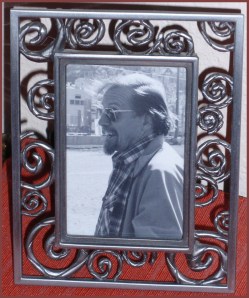
Terry, on the outside

If I’m out of my mind, it’s all right with me, thought Moses Herzog.

― Saul BellowHerzog

Saul Bellow, Miami Book Fair International, 19

Saul Bellow  (Photo credit: Wikipedia)

In 1965, television carried the sights and sounds of the bloody march on Selma, Alabama into living rooms across the country. Agitation over the Vietnam War was breaking out on campuses and in city streets, in both small towns and big cities. But the Stonewall riots were a few years away, and gay liberation was not yet on our collective radar screen. So it really isn’t odd that my first gay friend never came out to me and likely never even realized I knew he was gay.

Terry was medium-tall, about 25 pounds overweight, ruddy-skinned, with close-cropped dark, curly hair. He wore black horn-rimmed glasses that gave him, alternately, the look of a scholar or of a mad scientist. He lived in a wealthy suburb with his adoptive parents. The woman who gave birth to him was a distant relative of theirs. She lived in an apartment above a downtown department store, where Terry used to visit her. He seemed ambivalent about all three of these people.

I was attending college, but Terry wasn’t a student. He was part of the local theater scene, of which I was a hanger-on by virtue of being friends with some student actors. We were a loose-knit group of about a dozen kids with mixed economic and ethnic backgrounds.

Terry was energetic, sardonic, funny, and engaging. He amused and entertained everyone, often making himself the butt of his own jokes. But he could participate with equal aplomb in the deep, philosophical inquiries of the undergrad set. I found him more comfortable and easier to be with than most people I’d known all my life. We also found each other reasonably attractive and indulged in some innocent—although not harmless—necking. (I once contracted a serious case of mono from him that that required three days of hospitalization and a month of recuperation.)

Unless you’re completely exploded, there’s always something to be grateful for.

 ― Saul Bellow, Herzog

During most of this time, I had a stuttering romance going with David, a thin, intense, brooding young actor/student who appeared to survive on caffeine, aspirin, cigarettes, vitamins, and cereal. David, Terry, and I hung out together, often occupying booths or counter space in one of the all-night restaurants that were so much more common back then. We talked constantly, logging thousands of hours of conversation in person or over the telephone. We were into the novels of John Updike and Saul Bellow, so I imagine we discussed Rabbit Angstrom, George Caldwell (The Centaur), and Moses Herzog.

Some people, if they didn’t make it hard for themselves, might fall asleep.

 ― Saul Bellow, The Adventures of Augie March

One night in the middle of winter, Terry and I were driving around in a car I had borrowed. I forget why, but it was suddenly imperative to him to lay his hands on some money. He knew the combination to the safe in his father’s business office, so he decided to break into it. But first I had to return the car, which meant we were on foot more than 25 miles from his father’s office.

We slogged several miles across icy streets and sidewalks, growing increasingly numb from the cold, to the home of Marian-the-Librarian. Marian was the head of the Children’s Department of the public library, where I had once worked, and we were still friends. But she was in her 60s and lived alone, so I’m surprised she even opened her door. But she let us in, gave us something hot to drink, and agreed to lend us cab fare.

The cab dropped us off at a restaurant, where we ordered coffee. Terry downed his quickly and set off to try to find another car. Hours passed, though, as the waitress kept refilling my cup and giving me sympathetic looks. I realized Terry wasn’t going to return, but I didn’t have enough money to pay for the two coffees.

Eventually it got to be morning, and I called a friend to come pick me up and pay for the coffee. I never learned the outcome of that particular escapade, but it was adventures like that that often earned Terry time alone for reflection behind one set of locked doors or another.

He had several stints in the state mental hospital, from which he wrote me regularly. One weekend, David and I drove halfway across the state to see him. It was a warm, sunny, summer day, and David and I were both in a good mood. We made up names for fictional characters by combining place names from a roadmap: Crystallia Goodheart (heroine), Joppa Scott (villain), Sagola Volney (possible pen name for me). We fantasized about starting a business to provide characters (names and descriptions) to lazy novelists.

It seems, after all that there are no nonpeculiar people.

― Saul Bellow, Humboldt’s Gift

Terry was delighted to see us, garrulous and clowning around as usual: jovial tour guide of the nut house. Once he was released, the three of us picked up where we’d left off.

A few years later, he started talking about moving to Boston and making oblique references to a “marriage of convenience.” I assumed he never elaborated because he thought I didn’t know what he was talking about. It didn’t occur to me that he might have enjoyed being mysterious. In any case, he wanted me to move to Boston, too, and I considered the idea. But I ended up going to California instead, and we lost track of each other after that.

Out of the blue, during the winter of 1977, I started thinking about Terry quite a bit. I felt a strong urge to find out where he was and what he was up to, but I didn’t follow up on it for several months. His adoptive parents were no longer listed in the phone book, for one thing, and I was out of touch with everyone else who’d known him. But the urge persisted, and eventually I located the name and address of a possible relative. I wrote to him asking for Terry’s current address.

The man turned out to be Terry’s uncle. He called me as soon as he got my letter to tell me Terry had committed suicide in Boston six months earlier—right around the time I’d started thinking about him again.

I don’t delude myself that if I’d found a way to get in touch with Terry earlier he wouldn’t have killed himself. That would be presumptuous. There’s no way for me to know what was actually going on with him. But when I found out what had happened, I felt like a member of a mountain-climbing expedition who got distracted and looked away. And in that moment of looking away, I failed to see another member of the party lose his footing and fall, fatally, to earth.

We are funny creatures. We don’t see the stars as they are, so why do we love them? They are not small gold objects, but endless fire.

― Saul Bellow, Henderson the Rain King

‘tis the season to be buoyant

buoyant morning

buoyant morning (Photo credit: Pedro Moura Pinheiro)

With the arrival of the winter solstice last week, I needed to choose a new keyword for the next three months. The first (and last) time I chose a keyword for a season, I did it without putting much thought into it. Velocity came to me immediately, and so did the accompanying theme song, Glad Tidings by Van Morrison. Somewhere along the way, I realized that focusing on velocity without having first determined my direction was like sending a driverless race-car speeding 100+ miles per hour along a track. Nothing good was likely to come of it. So I paused to set a couple of goals.

This time, I wasn’t quite so hasty. I discarded my first choice of keyword, focus, when I realized focus is one of those things that repeatedly gets me into trouble. I don’t usually have difficulty focusing. On the contrary, what I have difficulty with is stepping back and loosening the reins of my focus. Sometimes circumstances change, you know? But I’m nothing if not persistent, so it often takes me a while to notice and then to back off or switch gears.

What I came up with for my winter keyword is buoyant. If I haven’t mentioned it yet, I really dislike winter. I dislike the cold temperatures, the noisy furnace, the layers of clothing, the short days, the gray skies, and the snow (when we get it). Winter feels heavy and oppressive to me. If I could wear shorts, sandals, and a T-shirt year around, I would. It takes temperatures hovering around 100 degrees before I comment on the heat. I’ve hiked the Sandia foothills in the mid-afternoon in the mid-90s. You just have to slather on the sunscreen, wear a hat, take plenty of water, and try not to run a marathon out there.

So the three months between December 21st and March 21st are my least favorite of the year—a trial to get through. This year I’m going to try a different tactic by attempting to lighten up, loosen up, and be a little more cheerful. Along with cheerful, lively, and sprightly, a few other synonyms for buoyant are:

Bright
Sunny
Animated
Genial
Blithe
Light-hearted

All good stuff, but it gets even better because buoyant also means:

Expanding
Developing
Strong
Thriving
Vigorous

Since I’m working on a new venture right now, this sense of the word buoyant is ideal for that, too. The third definition of buoyant refers to being light and able to float on water. Large bodies of water and I are not friends, so although I love this concept, it’s a little edgy for me. But that’s OK; a little edginess never hurt anyone. And light is the opposite of heavy, which is good.

now i know how it feels
to have wings on my heels

The search for a theme song also took longer this time than it did before. A lot of songs came close, but none of them hit exactly the right note. Then I came across this one by, of all people, the Moody Blues, from To Our Children’s Children, and it’s perfect.


Floating free as a bird
Sixty foot leaps, it’s so absurd
From up here you should see the view
Such a lot of space for me and you
Oh, you’ll like it
Gliding around, get your feet off the ground
Oh, you’ll like it
Do as you please with so much ease
Now I know how it feels
To have wings on my heels

I confess to having owned several Moody Blues albums way back when, but I don’t think I had this one.  And I probably wouldn’t have chosen this song for one of my playlists in the normal course of events. But the purpose of choosing a keyword is to aim my attention in a different direction, to consider things from a different perspective, and to get out of my usual mindset. In this case, to be more buoyant!

Do you have a keyword for winter? If so, please share it.

happy holidays!

Light Flowers<br /><br />Albuquerque Biopark River of Lights

Light Flowers
Albuquerque BioPark River of Lights

Birds<br /><br />Albuquerque BioPark River of Lights

Birds
Albuquerque BioPark River of Lights

Coyote<br /><br />Albuquerque BioPark River of Lights

Coyote
Albuquerque BioPark River of Lights

sweet dreams

Guitar player at Section 3

Guitar player at Section 3 (Photo credit: Dennisworld)

Some got clean, and even though you knew the blood, sweat, commitment, and years that had taken, it still felt like a fall-down-on-your-knees miracle every time. Some died (overdose, accident, murder, disease).

Mark did both.

He walked into his first detox group at the methadone clinic wearing a grey fedora cocked at a jaunty angle—swaggering but humble, willing but stubborn, in-your-face but respectful—giving off sparks that hinted he could accomplish the next-to-impossible. He could get clean. I began to wonder, how can I prove to myself that I am real and a part of this mad world I had been watching through blurry rain-soaked glass?

He got into the methadone maintenance program and I was assigned as his counselor. He defied everyone else’s expectations, but not his and not mine. Happy Valentine’s Day. You gave me (didn’t you?) hope.

Mark was in and out of jail while he was on methadone and wrote me long letters from his cell. I wonder if anyone knows how much or how useless this place really is for someone like me.

Otherwise, he lived in his car, an older model orange BMW he cherished. He was a heat-seeking missile bent on getting laid, so he had to keep up appearances. Almost got some today. My friend Kelly was being awful affectionate.

When his guitars weren’t in hock, he played bass, so he had that musician cachet going for him. And at one point, he owned two vehicles: the BMW he drove and a green Volvo he slept and stored his belongings in. I’m sitting here in my Volvo and my alarm starts sounding, but I can’t find my clock, right? So I’m digging all around and I’m finding all kinds of stuff I’ve been looking for, but the clock is still beeping, and I can’t tell where from. I finally find it in the back under some clothes, and what does it say—“Group Men’s 5:30 pm.” Whoops. Late again.

Mark’s openness was sometimes unnerving. Baring all doesn’t bother me because that’s how you will know who I am.

My expectations for him were relentlessly high. He attended two groups and two individual counseling sessions each week. I get a lot of encouragement from you, and seeing you keeps my commitment to you to stay clean fresh in my mind. I know I will have to be able to do that on my own, but isn’t that what recovery is about—support while you learn how to be strong without drugs?

We pushed each other’s buttons and challenged each other to dig deeper, to try again—try harder, try something else, something new—to push through it (whatever “it” was), to extend ourselves further, both within our respective roles and outside of them. I became a better counselor because Mark forced me to get real with him. All I can do is tell you how I feel about it and hope you see that it is as important to hear what you’ve been through as it is to tell you my story or feelings.

He got off dope. I was thinking about how dumb it was when I used to get depressed, and I would go out and use depressants to try and not be depressed, and they just made me more depressed. Duh!

After a community service gig revealed his talent for working with computers and he started earning money, he rented an apartment and got a cat. When he tapered off the methadone program after two years, clean (but not entirely sober), it was unusual enough that everyone on staff signed a congratulations card for him. Maybe my situation is almost the same, but the way I see the world and the way I make decisions and the way I feel about myself is all different. Cool, huh? Well, I think so, anyway.

Of course, Mark’s road had more rough patches, but he was never homeless again. I’m at a point where I’m just glad to be here, no matter why I’m here or what I’m doing.

And when he got together with Leslie, it was as if the last star in his personal constellation had finally fallen into alignment. Someday I’ll meet someone that I can be with who is what I’m longing for, and I can be for them the same. Not to try and make someone happy, but to augment their life and them mine.

Mark never relapsed to heroin. Haven’t, wouldn’t, couldn’t, didn’t, won’t, can’t and shouldn’t use.

It was alcohol that did him in. He was a maintenance drinker, and in spite or because of health problems, including Hepatitis C, from years of drug abuse and poor medical care, he wouldn’t, couldn’t, didn’t completely give up beer. He was 56 when his liver failed, 15 years after he came to the clinic. Well, I’m beat. I’ll see you tomorrow. Sweet dreams. Love, Mark.

I don’t know how many of my former clients are still clean (too few!) or how many are now dead (too many!). The others who I know have died—Jim, Dylan, Scott, Ray, Mark S, Alex, Rocky, and Russ—were all luminous and maddening souls. Each one fought hard—with humor and determination. Each one lifted me up, pissed me off, made me proud, and broke my heart. Each one infused me with enough hope to try again with someone else. Their passing has left holes in the world, openings you can sometimes glimpse when you look up into the night sky.

Sweet dreams, you guys. I’ll see you tomorrow. Love, Joycelyn.

permission to fail

FAILURE IS REALLY YOUR BEST OPTION

(Photo credit: American Artist Ben Murphy)

A handful of quotes to inspire you to fail and fail again because failure is an essential part of the creative process. It’s also a part of life.

If we’re not failing, we’re just not trying hard enough.

So go out there and fail better, fail faster. Rack up as many failures as you possibly can!

An essential aspect of creativity is not being afraid to fail.

–Edwin Land

Success is going from failure to failure without losing your enthusiasm.

–Winston Churchill

The man who makes no mistakes does not usually make anything.

–E. J. Phelps

It takes sixty-five thousand errors before you are qualified to make a rocket.

–Werhner von Braun

Forget your perfect offering. There is a crack in everything. That’s how the light gets in.

–Leonard Cohen

I have missed more than 9,000 shots in my career. I have lost almost 300 games. On 26 occasions I have been entrusted to take the game-winning shot… and I missed. I have failed over and over and over again in my life. And that’s precisely why I succeed.

–Michael Jordan

To develop working ideas efficiently, I try to fail as fast as I can.

–Richard P. Feynman

Would you like me to give you a formula for success? It’s quite simple, really. Double your rate of failure. You are thinking of failure as the enemy of success. But it isn’t at all. You can be discouraged by failure—or you can learn from it. So go ahead and make mistakes. Make all you can. Because, remember, that’s where you will find success.

–Thomas J. Watson

An inventor is almost always failing. He tries and fails maybe a thousand times. If he succeeds once then he’s in.

–Charles Kettering

I failed my way to success.

–Thomas Edison

Ever tried? Ever failed? No matter. Try again. Fail again. Fail better.

–Samuel Beckettt

To be wrong is nothing unless you continue to remember it.

–Confucius

Also:

The best way to have a good idea is to have a lot of ideas.

–Linus Pauling

If I have a thousand ideas and only one turns out to be good, I am satisfied.

–Alfred Nobel

So try not to be too attached to any of the ideas you currently have.

sittin’ with the kitten

The Bedroom Chair

The bedroom chair.

There’s no one here to take a picture of the two of us (Naima and me), but this is the chair in which I spend time each and every morning doing what I call sittin’ with the kitten. Naima isn’t really a kitten anymore at two years and nearly four months old, but she’s still quite kittenish and playful.

I can’t recall how we got into this habit. There’s another white wicker chair in the living room next to the tallest cat tree, and that’s where we first started doing this. At some point we switched to my bedroom, which has a large window facing a grassy area and a bird-filled tree.

I’m a creature of habit in the morning, and Naima has learned my habits well. She precedes me down the hall first to the bathroom and next to the closed door of my office. Then she waits while I get all my computer equipment turned on, open the blinds in the living and dining areas, and get the water heating for my coffee before I feed her. After she eats her breakfast, she plays with her toys while I finish fixing cereal or toasting an English Muffin.

I eat breakfast in front of the computer (nasty habit). When Naima’s done playing, she comes and sits just inside or just outside my office waiting for me. I’d say waiting “patiently,” but it’s hard to ascribe patience to a cat. After I finish eating, I take the rest of my coffee back to my bedroom.

Sometimes, Naima lags behind a little. If she’s not in the room when I sit down in the wicker chair, I say, “Where’s the kitty?” That’s her cue to peek around the corner and then come running over. She prefers to get up into my lap from the left side, so she might have to circle the chair before jumping up. Then she settles against my chest, with her head near my left shoulder, and we snuggle for a while.

white space

This is usually the only white space in my day. If you don’t know the term, here’s a chunk of information from Wikipedia:

In page layout, illustration and sculpture, white space is often referred to as negative space. It is the portion of a page left unmarked: the space between graphics, margins, gutters, space between columns, space between lines of type or figures and objects drawn or depicted. The term arises from graphic design practice, where printing processes generally use white paper. White space should not be considered merely “blank” space — it is an important element of design which enables the objects in it to exist at all, the balance between positive (or non-white) and the use of negative spaces is key to aesthetic composition. When space is at a premium, such as some types of magazine, newspaper, and yellow pages advertising, white space is limited in order to get as much vital information on to the page as possible. A page crammed full of text or graphics with very little white space runs the risk of appearing busy, cluttered, and is typically difficult to read. 

I worked in the Retail Advertising Department of a newspaper for several years, which is where I became familiar with the term. Then a year or so ago, a newspaper copy editor blogged about the idea of incorporating white space into one’s day—to serve the same purpose as white space in an ad. Cramming the day with activity after activity with no time to just be leads to a cluttered mind, he suggested. It’s hard to take a deep breath when we’re always focused on or engaged in something, always trying to complete a task, converse with someone, or solve a problem. I agree. There’s almost no white space in my day–except for the time I spend sittin’ with the kitten.

be here now

Looking down from above.

Naima atop her perch. Be Here Now.

After Naima has had enough cuddling, she moves over to the cat tree, gives herself a bath, and then arranges herself on one level or another to watch what’s going on outside. I finish my coffee. And look out the window. And talk to her a little (her tail swishes in response). I’ve thought of bringing a book in there to read once she gets off my lap. Or a notepad to jot down the list of things I need to do or whatever random ideas may occur to me. You know–do something useful. But no. Then it wouldn’t be white space, anymore.

If I’m preoccupied, Naima notices. She reminds me to be present with her. A couple of years ago, when I was tutoring kindergarten students in the Albuquerque Reads program, one of my students, Angel, was very bright but easily distracted. One day, I heard myself say to him, “Angel, be here now.” He interpreted that to mean “pay attention.” Whenever he noticed he wasn’t paying attention–maybe it was a look I was giving him–he’d say, “I know. Be here now.”

At the end of the tutoring year, I created a card for him using a photo of Naima looking very sternly and  intently into the camera. I added the caption Naima says: Angel, BE HERE NOW, which he got quite a kick out of. I wonder what his parents made of it.

The fact is I’ve gotten some of my best ideas sitting in that wicker chair in the morning without really trying to have them. So I don’t let anything intrude into this white space. It’s one of the most important parts of my day. I’m sure Naima would agree.

what i’ve lost

RC Jones

RC Jones

Losing someone who has been an integral part of your life for years or even decades is an enormous loss, of course. But that enormous loss is really an accumulation of many smaller losses you only begin to recognize over time.

In the year after my partner of 30 years died, when I began to notice those small losses accumulating, I completed a long-list journal writing exercise to enumerate them. To acknowledge them. To help me understand.

Chances are you’ve lost someone as important to you as he was to me, and you have your own list of what that looks and feels like.

what i’ve lost

Someone to:

  • Come home to
  • Complain to
  • Hang out, watch TV, and read the Sunday papers with
  • Make scones for
  • Pick me up from work
  • Share my life
  • Share my time
  • Get grumpy with
  • Walk with & hike with
  • Shop with
  • Be indignant with (and about)
  • Share the sunset with
  • Remember 30 years with
  • Do projects with
  • Learn and grow with
  • Care for
  • Talk to
  • Share space with
  • Complain about
  • Figure things out with
  • Make plans with
  • Discover things with
  • Have holidays with
  • Share food with
  • Take care of the car
  • Return my books to the library and take my clothes to the cleaners
  • Make meal plans and grocery lists with
  • Watch DVDs with
  • Watch football games with
  • Have quirky habits with
  • Laugh with
  • Hope for
  • Nag
  • Have serious discussions with
  • Make me birthday cards
  • Play Scrabble with
  • Take for granted
  • Look out the window and watch for
  • Do the messy chores
  • Worry about
  • Buy Valentine’s Day cards for
  • Remember my birthday
  • Watch a fire in the fireplace with

Someone who:

  • Was always there
  • Knew me for better and worse and still stuck around
  • Wanted me to listen to his music
  • Took care of all the plants
  • Supported me 100%
  • Could fix almost anything
  • Would read my writing and give me GOOD feedback
  • Was smarter than me
  • Liked to cook (and was great at it)
  • Was willing to clean up the kitchen, do the dishes, and take out the trash
  • Listened to me, almost anytime
  • I could tell about my day
  • Always told me about his day
  • Was interested in what I was interested in
  • Got along with my mother (!)
  • Moved to Albuquerque with me
  • Offered to tell me bedtime stories
  • Used headphones for TV at night so he wouldn’t disturb me
  • Made the best of the situation
  • Forgave me
  • Always gave me his full attention
  • I could buy little surprises for
  • Remembered more of our past together than I do
  • Loved me unconditionally
  • Missed me when I went away
  • Picked me up at the airport, no matter what time
  • Filled the patio with blooming cactus plants
  • Accepted my shortcomings
  • Subscribed to interesting magazines
  • Was the one to go out to pick up our take-out food
  • Was nice to my friends
  • Made sure my coffee was ground exactly the way I liked it
  • Called me “babe”
  • Grilled the chicken, sliced the avocados, sharpened the knives
  • Apologized after an argument
  • Gave me my space
  • Noticed butterflies
  • Introduced me to so many different things
  • Cast his lot in with mine
  • Put up with my periodic insanity
  • Saved things
  • Was more sentimental than I am
  • Gave more than he got
  • Needed me
  • Trimmed my bangs
  • Took the cat to the vet
  • Worried about how I would get along without him
  • Supported me financially when I needed it
  • Drank way too much Diet Coke
  • Could be really silly
  • Had an eye for beauty
  • Was always writing letters to the editor in his head and then “reading” them to me
  • Watched the 10:00 news religiously
  • Hung all the pictures on the walls
  • Liked to talk…and talk…and talk
  • Tried to tell me jokes disguised as anecdotes because I hate jokes
  • Never liked to take the last of anything
  • Could never purchase just one apple, orange, or head of garlic
  • Loved the smell of roasting chiles in the fall
  • Still appreciated the bathrobe I got for him after wearing it for seven years
  • Said he liked hanging out with me
  • Made really good banana bread
  • Lived with a lot of physical pain but tried not to let it get in the way
  • Wore a hat I crocheted for him back in the 80s
  • Loved to look at the changing light across the Sandias
  • Could see into the center of things
  • Was proud of me
  • Was enchanted by snow and luminarias
  • Had a sparkle in his eye
  • Laughed with abandon
  • Had an amazing book and record collection

He was:

  • A poet
  • A writer
  • An artist
  • A gardener
  • A musician
  • A spiritual companion
  • A partner in life
  • My best friend
  • My heart

And I still miss him.

doodlin’

Once upon a time, in a life far far away, I came upon the instructions for an activity called creative doodling. Before describing it, though, I have to confess to a tendency I may have been born with to absorb activities like this one and then immediately turn around and teach them to any person or group halfway willing to give them a try. I used to say about myself that I was born to disseminate information. But the complete truth is that I was also born to show you how to do this stuff–whether you want to do it or not. Well, I haven’t actually hogtied anyone yet. That would be kind of counterproductive when it comes to creative doodling.

Creative doodling is an art therapy exercise, but don’t let that put you off. It’s also fun. And so easy to do. Start with your dominant hand.

  1. Get out a couple of pieces of drawing paper (larger is better), masking tape, and some colored markers or crayons.
  2. Tape a piece of paper to a flat surface with masking tape to keep it from moving around.
  3. Choose a marker or crayon.
  4. Close your eyes and run your hand over the page to locate the edges.
  5. With your eyes still closed, start drawing on the page. Don’t lift the marker off the paper; your drawing should be composed of one unbroken line.
  6. Don’t try to draw anything in particular. Just let your hand (and marker) wander all over the page until you feel like you’re done.
  7. Open your eyes and check out your work. Look at it this way and that (sideways, upside down) until you find an image in it. The image can take up most of your drawing or only a portion of it. It can be fairly complete or only hinted at.
  8. Once you’ve found your image, use the rest of your markers to elaborate it.
  9. When you’re done, title your drawing.
  10. Repeat with your non-dominant hand. (You can use your dominant hand to finish the drawing.)

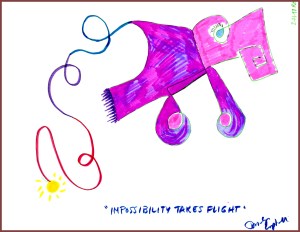
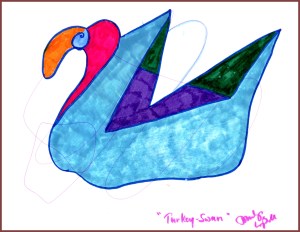
These are examples of two of my creative doodles, the first with my right hand and the second with my left hand.

Right hand: Impossibility Takes Flight

Right hand: Impossibility Takes Flight

Left hand: Turkey-Swan

Left hand: Turkey-Swan

I include them to demonstrate that NO artistic talent whatsoever is required for this activity.

I love color and I enjoy coloring, so sometimes I do this just for fun. But it’s an activity that can also provide a little personal insight if you take the extra step and either journal about the pictures or at least tell yourself their stories. Another thing to do is write down the first five or six words that come to mind when you look at a finished drawing.

This doodle, Bird’s Eye View, is one of my favorites.

Right Hand: Bird's Eye View

My doodles tend to include a lot of critters, among them a one-eyed flying fish and a rather demented frog. That’s just what I see. So now you know.

CDZA: collective cadenza of crazy good music

CDZA is composed of many musicians, some from Julliard School of Music and other music schools such as Manhattan School of Music, Berklee College of Music, and Brooklyn College of Music, along with several Broadway singers. For the past nine months they have been working on a project to create “musical video experiments.” These are some of my favorite results. But there are many more, so check out their website.

What a Wonderful World as you’ve not heard it before:

It’s too late to order fries:

Great singer–and I love the guy in the Elton John glasses:

A little sad; a lot funny:

eve dreams (novel excerpt)

An excerpt from my novel-in-progress, Skin of Glass.

Red sunset

Red sunset (Photo credit: Wikipedia)

Eve dreams she’s naked and nailed to a wooden cross on the side of a hill. The rest of the hillside is planted and staked with symmetrical rows of grapevines. The sun is setting straight ahead of her and the cloud-filled sky is a tumultuous gothic wash of purples, golds, mauves, and deep blues. It reminds her of the sky on the holy pictures she collected when she was eight or nine years old and stuck between the pages of the prayer book her grandmother in Illinois sent her. To the right and down the hill there’s a small clearing with wooden tables and benches where a group of people is having a party or a picnic. She recognizes the voices: her mother, her father, Nana and Jack, and her cousins, aunts, and uncle. Ethan and Jesse are there, too. They’re talking and laughing among themselves, paying no attention to her. As the sky darkens, they light some small candles.

Eve isn’t cold and she doesn’t feel any pain, but she can’t bear being so exposed and powerless.

When the sun finally sets, there’s no moon. The only light comes from the candles, which begin to flicker wildly as a warm wind moves toward the table. The wind snuffs out first the candles, then the voices. When Eve can no longer see or hear anyone, calmness settles over her. She slips free of the nails and glides, like a bird on a current of air, away from the hillside, away from everyone, into the darkness and something unknown.

Eve wakes up suffused with the memory of flying and of freedom. But she’s stuck fast, pinned like a butterfly to the bed, where Ethan’s right leg and arm hold her down. She thinks the phone might have rung, looks at the clock, tries to adjust her legs. It’s only eight thirty. And it’s Saturday. She closes her eyes and sinks back into sleep.

The ringing phone wakes her again and Ethan stirs, allowing her to move his arm and leg so she can get out of bed. She grabs a T-shirt, pulls it over her head, and hurries down the hall, brushing hair out of her eyes.

“Hi, honey.” Her father’s voice is low. “Did I wake you?”

“It’s OK, Dad; I should be up anyway.”

“I just wanted to confirm I’m picking you up at six-thirty tonight.”

Eve is instantly wary. That’s the time he always picks her up for dinner.

“Were you out last night? I called but your machine picked up.”

She can tell he’s making an effort to keep it casual, but her muscles still tense and she grips the phone tighter. “Dad! Are you checking up on me?” Of course, if she weren’t keeping things from him she wouldn’t have this problem. She makes an effort to soften her tone. “Hey, where are we going tonight, anyway?”

Silence.

“Dad?”

“Your choice, honey. I’ll see you at six-thirty.”

She hangs up. The weight of his concern feels like a force of gravity, anchoring her to the ground, making her clumsy and slow.

She stops briefly in the bathroom, opens the medicine cabinet, and looks at the bottle of Valium. Then she closes the cabinet door, pads back to the bedroom, and climbs into bed beside Ethan. Now awake, he nuzzles her chin with his beard, kisses the hollow of her neck.

“Who was it?”

“My father.”

“What did he want?”

“He wanted to talk to me. If the two of you are so interested in each other, why don’t you just get together and stop using me as a go-between?” She regrets taking out her frustration on Ethan as soon as the words leave her mouth.

“You know I’m not interested in your father,” Ethan says, evenly. “I only ask out of self defense.”

She sighs. The tightness at the base of her skull means the start of a headache. Ethan lifts her T-shirt away from her breasts and lightly licks a nipple until it hardens. He’s in the process of pulling the T-shirt over her head when the phone rings again. With another sigh, Eve takes hold of her shirt and pulls it back down. As she starts to get out of bed, Ethan reaches an arm around her waist to keep her there. “Let it ring. Daddy Dearest can wait.”

She pushes his arm away, gets up, and walks back down the hall. She returns a few seconds later. “It’s for you.”She pulls her terrycloth robe from the hook on the back of the door and heads to the bathroom.

In the shower, Eve lets the hot water beat against her neck and shoulders, as she examines a nickel-sized dark purple bruise on her hip that flares dramatically against her milky white skin, trying to remember how she got it. A smaller bruise on her right elbow, where she smacked it against the doorframe, is already fading. She’s been so uncoordinated lately. She tests the outside of her thigh for soreness, then takes a long time washing every part of her body.

When she shuts off the water and pushes back the shower curtain, she finds Ethan braced against the sink, staring at her. He’s wearing the dark blue bathrobe she gave him for Christmas, which he keeps in her apartment. He’s holding a mug of steaming coffee that he hands it to her without comment. She turns her body sideways as she steps out of the shower, hoping he hasn’t noticed her latest bruise. She accepts the mug and takes a couple of sips before handing it back and drying herself off with a large white towel.

As he watches, she wraps another towel around her wet hair and puts her bathrobe on.

“Do you want to know why she called?”

“I don’t even want to know that she exists, Ethan! Why would I want to know why she called?”

“Eve…”

“She’s the mother of your child. She has 24-hour access to you. She has my fucking telephone number!” As if from a distance, Eve listens to herself losing control. She yanks the towel away from her head and throws it on the floor. She grabs her brush and furiously tugs at her tangled wet hair. The day has already slipped away from her, spinning off into a gloomy darkness, yet she’s powerless to dial down the stridency in her voice. She can’t ask Ethan to stay, even though that’s what she wants to do. Her face sets in a hard, closed expression.

Ethan goes into the bedroom, where Eve hears him getting dressed. She’s still brushing her hair when he reappears in the doorway. “I have to go.”

“Of course you do.” This is the one Saturday of the month Ethan doesn’t have Molly. Correction: the one Saturday he wasn’t supposed to have her.

“I’ll call you this afternoon. Do you want me to pick something up later for dinner?”

She shakes her head. “I’m having dinner with my father.”

“Ah.” He nods.

She looks at his reflection in the mirror and feels the air between them thicken, the space between them expand. She wants to touch him, to say something, but she’s stuck to this spot and he feels too far away, already gone.

She hears his footsteps on the bare wooden floor, the thud of the front door closing. She puts her hairbrush down, opens the medicine cabinet, and takes out the bottle of Valium. She washes down two pills with the cooling coffee from the mug Ethan left on the counter. As she swallows the rest of the coffee, she closes her eyes, leans against the edge of the sink, and tries to remember what she dreamed about this morning—something good, wasn’t it? Something about flying.

Post Navigation