give me a daisy

~ ~ ~ ~ read ~ write ~ look ~ listen ~ create

Archive for the month “January, 2013”

time, time, time, see what’s become of me

Atomicclock

Atomicclock (Photo credit: Wikipedia)

Lately, I’ve had more things to do than time in which to do them, i.e., I feel as though I don’t have enough time. I know–and you know–that time is not a commodity, much as we often treat it as one. But it’s difficult to stop thinking of it that way. When a friend commented in a blog post that there was no way to create a savings account for time, I immediately perked up. Wouldn’t that be great? I want one of those!

When I met the
Grandfather of
Time, he said
it was no use
struggling.

Even after all
these years he
still had too
much to do.

Running Behind (Brian Andreas)

That doesn’t give me much hope that my relationship with time, and the lack thereof, is likely to change anytime soon.

what is time, anyway? it’s:

  • a nonspatial cotinuum in which events occur in apparently irreversible succession from the past through the present to the future;
  • an interval separating two points on this continuum, measured essentially by selecting a regularly recurring event, such as the sunrise, and counting the number of its occurrences during the interval; duration;
  • a number, as of years, days, or minutes, representing such an interval;
  • a similar number representing a specific point, such as the present, as reckoned from an arbitrary past point on this continuum;
  • a suitable opportune moment or season;
  • an interval marked by similar events, conditions, or phenomena; especially a span of years; era;
  • one’s heyday;
  • a moment or period designated, as by custom, for a given activity; harvest time;
  • an occasion;
  • an appointed or fated moment, especially of death;
  • one of several instances;
  • a prison sentence;
  • the period spent working;
  • the rate of speed of a measured activity;
  • the characteristic beat of musical rhythm.

what does time do? it:

  • passes
  • expires
  • cycles
  • drags
  • hangs heavy
  • flies
  • flows
  • never arrives
  • marks changes
  • stands still
  • places limits
  • ages us
  • saddens us
  • gladdens us
  • gives us hope
  • preoccupies us
  • enslaves us
  • provides us with information
  • is money?

what do we do with time? we:

  • have time
  • have no time
  • save time
  • spend time
  • long for past times
  • want more time
  • look forward to future time
  • waste time
  • savor time
  • hoard time
  • pass time
  • lose time
  • lose track of time
  • fear time
  • serve (“do”) time
  • make time
  • take time
  • keep time
  • keep track of time
  • while away time
  • seize the moment/day
  • manage time
  • take time off
  • use time wisely

but does time even exist?

We have sophisticated machines, like atomic clocks, to measure time. But measuring “time” doesn’t prove its physical existence. Clocks are rhythmic things. We use the rhythms of some events (like the ticking of clocks) to time other events (like the rotation of the earth). This isn’t time, but rather, a comparison of events. We called these manmade devices “clocks.”

But these are just events, not to be confused with time. Indeed, one could measure time by measuring the melting of ice on a hot day. We might even devise a plan to meet for tea at two ice-cube melts or 50 top-spins, which ever “time piece” you each happen to have on hand. Clocks just have springs and things. People get sidestepped into believing time exists as a physical entity because we’ve invented clocks.

From a biocentric point of view, time is the inner process that animates consciousness and experience. The existence of clocks, which ostensibly measure “time,” doesn’t in any way prove time itself exists.

–Robert Lanza, M.D., Psychology Today

Well, whether time exists or not, we experience it; we live as if it is not only real, but often a cruel taskmaster. It might be more effective to try to make friends with time instead of fighting with it all the time.

I’ve already “spent” nearly two ice-cube melts on this post, but before I end, here’s a song about time from a long time ago:

hey jealousy (a short story in dialogue)

hey jealousy

Hey jealousy
She took my heart
Well there’s only one thing I couldn’t start

–Gin Blossoms

Lakeshore Records

Lakeshore Records (Photo credit: Wikipedia)

“Lexie? Is that you?”

“Mark? My God, I thought you were dead.”

“Oh, no. Nothing that serious. Just got a little dizzy after working out in the hotel fitness room. Guess I was dehydrated. I’ll be out in time to catch my plane. But, wow, how amazing to see you here, Lexie.”

“No. I mean I thought you’d died years ago. At the lake. When the Wheelers’ boat sank.”

“What? Well, obviously, the reports of my death have been greatly exaggerated.”

“But—”

“You look fantastic. As beautiful as the picture of you I’ve kept all this time. I’ll bet you’re an amazing nurse. Such gentle hands you had. I remember. I’ve never forgotten those weeks at the lake, the walks we took on the shore, sitting at the edge of the pier and talking so long we got sunburned. Sneaking out behind the back of the boathouse at night. That was a…special time. You were special.”

“But, Mark—”

“Sometimes I wish we could go back, don’t you? Life seemed simpler and sweeter then, without all the obligations, the fuss, the stress. You know what I mean?”

“Mmm.”

“You must have married, Lexie. I see a ring. Any children? Can you believe Veronica and I are celebrating our 30th at the end of the year? Frannie, our oldest, is married, teaching in Kentucky—Kentucky, for crying out loud. But she’s pregnant, so I doubt that will last much longer. God, I’ll be a grandfather soon. And Paul is almost through med school. ‘My son, the doctor.’ What a cliché, huh?”

“Veronica?”

“Of course you remember Veronica. You two were best friends. She’ll be so surprised when I tell her I saw you.”

“Surprised? Yes, I think she’ll be quite surprised.”

“What’s the matter, Lexie?”

“Tell me about Frannie. How old is she? What’s she like?”

“She’s twenty-nine. Pretty and smart. Hell-bent on having a career before settling down to raise kids. Didn’t want to be like her mother, getting married and having babies before she finished college.”

“And how is Veronica these days?”

“Oh, she’s fine. Stays busy with the house and the cabin. And she has her committee work with the arts guild and a couple other groups. Right now she’s in Kentucky helping Frannie get ready for the baby. We’re both excited about our first grandchild.”

“Why didn’t you ever call me, Mark? Or write?”

“I thought you didn’t want me to. You’d met someone else, hadn’t you? It was Veronica, come to think of it, who told me you’d left with him. I was in shock when she told me, Lex, to tell you the truth. I’d thought you cared about me the way I did about you.”

“I left the lake because my mother fell and broke her arm and needed my help at home. You were off hiking with some of the other guys, so I wrote a note and gave it to Veronica to give you. She came to visit me a few weeks later. I trusted her, so I confided in her. She told me about the accident with the Wheelers’ boat.”

“Yes, that was a terrible thing. Mr. Wheeler’s youngest son, Petey, drowned.”

“But you weren’t on the boat.”

“No.”

“And you and Veronica?”

“Rebound kind of thing, I guess. And then she got pregnant, so we got married right away.”

“Well, I have some other patients to attend to. It was good to see you.”

“Lexie?”

“Say ‘Hi’ to Veronica for me. And just so you know, Mark, your first grandchild is four years old. His name is Kevin and he takes after his father. We’re celebrating his baby sister’s first birthday next week. Michaela looks just like her mother did at that age.”

“What are you talking about?”

“Veronica Rose. Your oldest daughter’s name is Veronica Rose, but we call her Ronnie. She has your eyes. Same bright blue; same long, dark lashes. I remember, too, Mark. I remember every day. I’ll get someone else to look in on you now.”

the eyes of my eyes are opened

Sunlight is in short supply here in the Northern Hemisphere. But fires roar in  fireplaces inside our homes, crackling with light and heat to dispel at least a little of the gloom. Here Richard Feynman explains the nature of trees and how the heat and light of those fires is actually “stored sun” being released from the wood.

And here is a brief animation of his “Ode to a Flower.” Very short–and so worth looking at.

i thank You God for most this amazing

i thank You God for most this amazing
day:for the leaping greenly spirits of trees
and a blue true dream of sky; and for everything
which is natural which is infinite which is yes

(i who have died am alive again today,
and this is the sun’s birthday; this is the birth
day of life and of love and wings: and of the gay
great happening illimitably earth)

how should tasting touching hearing seeing
breathing any–lifted from the no
of all nothing–human merely being
doubt unimaginable You?

(now the ears of my ears awake and
now the eyes of my eyes are opened)

–e. e. cummings

Lost in Space Again

October 18, 1989 (Loma Prieta Earthquake)

photograph of a collapsed facade of a building...

photograph of a collapsed facade of a building near Beach and Divisadero Streets in San Francisco (Photo credit: Wikipedia)

Sabina held the dress up in front of herself and looked into the full-length mirror. Then she turned to me.

“That’s nice,” I said. “It makes you look like Gena Rowlands.” Gena Rowlands?

Sabina’s hair was much longer and pulled back into a pony tail. The shop we were in consisted of three rooms, sort of large walk-in closets. There were no salespeople in sight. I don’t remember if Sabina bought the dress. She is real, but the rest was a dream.

When I told her friend Lee about it, she said Sabina was supposed to be shopping for a dress for a wedding next month. So I described the dream dress in as much detail as I could. Now Sabina’s trying to find this dress that will make her look like Gena Rowlands.

As for me, I’m trying to find the man who wandered into Sabina’s kitchen while I was sitting alone at her table after our shopping expedition. His hair was full and dark, his skin a light olive. He was wearing a white long-sleeved shirt and dark pants. He sat down across the table from me and started speaking in a low-friendly voice.

I was preoccupied and kept asking him to repeat himself. He told me his name was Roy Walli and even spelled it: W-A-L-L-I. He said he liked jazz and played the oud. When I related this scene to a musician friend, he told me the oud is a lute-shaped Arabic instrument and that playing jazz on it would be difficult but not impossible.

After a short time, Roy got up to go. He apologized, saying he hadn’t meant to bother me. Suddenly, I didn’t want him to leave and protested that he wasn’t bothering me at all. He didn’t appear to believe me. After he left, I drank some white wine through a straw from an oversized goblet. Then I tried to look him up in the phone book. It had an unusually large number of sections, but his name wasn’t in any of them. Later, looking through a second-story window, I saw his name on an old-fashioned sign—the kind an auto repair shop might have—on a red brick building. It felt like a dead end.

Should I run an ad in the Pacific Sun? “Divorced white female, age 43, seeks literal man of her dreams.”

Saturday was the night of the full moon. I didn’t sleep very well. My stomach was churning, my heart was pounding, and my head ached vaguely. I seemed to wake up every half hour. Deep in the middle of the night, I found myself in an unfamiliar large two-story wooden house. I was looking through another second-story window watching the full-moon rise. My friend was asleep, but I called him over to the window to track the huge luminous moon’s ascent behind two distant hills.

He wasn’t much interested in the moon and went back to bed. I continued to stare out the window, maybe a little hypnotized. As the moon rose, it seemed to grow larger instead of smaller, and to cast more and more light. All at once, it was huge and glowing, and I could see splotches of color and texture: mauves and blues and purples stood out against the pearly white ground. A large round white cloud served as a gauzy backdrop behind it.

The moon cast so much light that far-away planets became visible. Everything outside the window took on the surreal appearance of a charcoal sketch. Nothing was in color anymore, and none of the normal daytime landscape was visible. Jupiter, trailing some kind of vapor, and Saturn and its rings were so close I could almost stretch out my arm and touch them.

I was awestruck, but the thought I might be the only one seeing it made me feel very isolated and deeply disturbed. I had a sense of all these huge planets, including the earth, floating in space with nothing to anchor them. It was disorienting and frightening. I felt as if I really could fall off the edge of the Earth.

Gradually, the moon rose higher in the sky, finally becoming smaller, its light dimming. The planets disappeared from sight and the world outside returned to normal. I must have stayed up all night because it was morning by then.

My friend and I woke up around seven o’clock, talked a little, and made love. He got up, but I fell back asleep. When I woke up the second time, alone, I could still see the clear, grey outline of Jupiter in the sky, and that sense of floating freely in space, unanchored, wouldn’t go away.

Yesterday, at four minutes after five o’clock in the afternoon, I was in Mill Valley, working alone at the far end of Sabina’s studio when the earth shook half a dozen marble slabs off the walls and sent them crashing down onto her desk and her paints and the floor. I don’t know where she was—maybe still looking for that dress. And I don’t know where Roy Walli was, either. Who was that guy, and just what was it he was trying to tell me that I was too preoccupied to hear? All I really got for sure was his name.

mandala daze

An assortment of colored pencils

An assortment of colored pencils (Photo credit: Wikipedia)

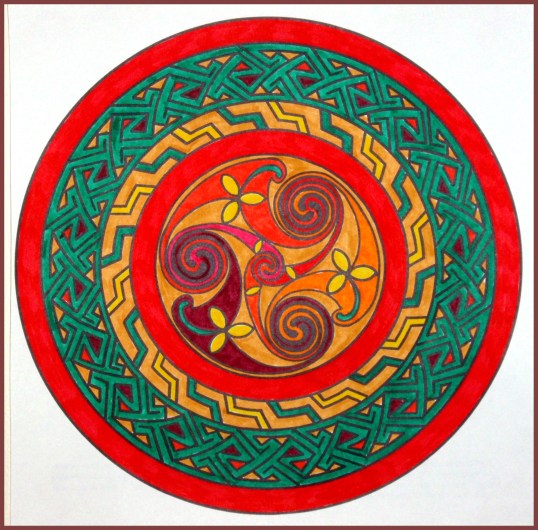
Under the influence of the friend I stayed with right after I moved to San Francisco in 1974, I bought a box of crayons and some colored pencils and jumped into mandala-making. The practice involved creating a new one each day. My first efforts were kind of crude, but the intention was to develop self-awareness rather than to create works of art.

Nevertheless, I was dissatisfied with the slapdash approach that seemed to be necessary in order to produce a new mandala every day. I started being more deliberate and spending more than one day working on each one. Right around then, I met RC (my partner of 30 years), who was a very talented artist. He was working with the mandala form on both small and large scales. He had a stash of drafting tools (among other stashes) and showed me how to use them (the drafting tools). We got into the habit of spending hours sitting together at the dining table, each working on our own drawings.

I made a couple dozen mandalas using markers and colored pencils and developed a heavy Prismacolor habit. We framed a few and hung them on the wall. But i stuck them inside a manila folder a decade or two ago and filed it away in such a safe place I haven’t been able to lay my hands on it for years. In the course of looking for it, however, I unearthed a number of other things I’d forgotten I’d kept or had lost track of. So it’s fitting that last week, while looking for something entirely unrelated, I finally found the manila folder containing the mandalas!

The ones I like best are:

Mandala #1

Mandala #1

Mandala #2

Mandala #2

Mandala #3

Mandala #3

Mandala #4

Mandala #4

Mandala #5

Mandala #5

Mandala #6

Mandala #6

Mandala #7

Mandala #7

Mandala #8

Mandala #8

All of these were created in 1975 and 1976, before the advent of the personal computer and scanner. It was a different time and place, a different way of life. That’s one of the reasons I’m glad to have found them. They remind me of living at a slower pace, of paying attention to things in a different way, and of the companionable evenings RC and I spent together.

I still enjoy coloring mandalas occasionally, but even though I have that stash (of drafting tools) around here somewhere, I haven’t taken the time to draw my own designs in so long it seems unlikely I’ll ever do it again. But that’s OK. That was then, and this is now.

Is there something you once really got into and enjoyed, but that you no longer do–or maybe no longer even think about?

soloist (a poem)

MOON

moon (Photo credit: Nick. K.)

You pass through glass
(thick, leaded, amber panes)
into moments . . . doors opening and closing,
exposing the visible threads of your soul
to the brightlight: rhythms of dreams,
fractured fantasies,
and wrung-out visions of a holy life.

You hold your breath and stare
as time explodes around you
feeding your senses such seductive visions of hell
(the sight of people coming and going);
and the world arranges and rearranges itself
into patterns of roads that you watch
like a TV show
for signs of life.

Someone (something) is always moving,
toward you or away,
while you remain unmet,
framed in the doorway, entranced
by images refracting to the surface,
playing them out on silver strings
(your silver wings);
playing only to the moon at night,
you pass through glass.

Russell Crowe and Les Mis: a match made in…

Les Miserables

Les Miserables (Photo credit: AndyRobertsPhotos)

…heaven or hell? Every year on New Year’s Day, my friend Gayle and I see a movie and then have dinner afterward. This year, unlike some others, there wasn’t a clear favorite, so we settled on Les Miserables. Neither of us had seen any incarnation of the stage version, but it’s one of her favorite novels (which I admit to never having finished), and she had some trepidation about the potential trivialization of the story.

With neither the book nor the stage version to compare it to, I judged the movie on its own merits and found it to be a good production overall. I knew the vocals had been sung live and not in the studio, so I wasn’t expecting them to be perfect. (They weren’t “sweetened” in the studio afterward, either, a term I just learned.) The actors all seemed to inhabit their characters quite well and to do a decent job with the singing, with a few really outstanding performances (especially by Samantha Banks). But some characters seemed more human than others.

The person I was most impressed with was…Russell Crowe. So I was really surprised to discover all the Russell Crowe bashing taking place on the internet. “Epic fail,” claimed one headline. Had we seen different movies?

At dinner, Gayle said she realized the reason she likes opera but doesn’t generally like musicals, is that opera singers have trained voices and the actors in musicals often don’t. Philistine that I am, I do not like opera, so I don’t feel let down when the actors in musicals don’t measure up to opera singers. Yes, I was aware that Russell Crowe’s singing was not first rate. But I didn’t feel that it detracted from his performance–and maybe it even added to it.

He seemed very believable in a difficult role. He brought nuance to it. His inner struggle was something I could relate to. At times, he even moved me–more so than some instances where I was supposed to be moved. I haven’t seen him in very many movies, but he was great in one of my long-time favorites, L.A. Confidential, where he also played an officer of the law, a corrupt, head-bashing Hollywood cop who is redeemed by the love of Kim Basinger.

let’s hear it for the pub voice

English: Russell Crowe

English: Russell Crowe (Photo credit: Wikipedia)

I’m definitely not the only one who thinks Crowe did well in the role of Javert. Here’s an excerpt from a post in the Hollywood Prospectus blog on Grantland, by Charles B. Pierce, In Defense of the Pub-Voiced Russell Crowe in Les Miserables.

[Crowe] doesn’t have the big moment that Anne Hathaway does — after, of course, she gets beaten to a pulp in the most extended filmic martyrdom since Mel Gibson got a hold of the Gospels — and he doesn’t have the ongoing halo that surrounds everything Hugh Jackman does, but, in a very strange way, and in a way I never did with Javert either in the novel or in the straight dramatic movies made out of it, I identified with his character because he seemed like the only ordinary bloke on the screen.

Javert is an impossible character, the most rigid person in literature except, possibly, for Ahab, who at least has a deep personal wrong to be avenged. But Crowe manages to humanize him and, because he does, Crowe’s the only real actor in the film. Everybody else — except the comic-opera Thenardiers, whose every appearance had me wishing for a general cholera outbreak — is a saint with celestial pipes.

I’d watch the movie again, if only to see if my original impressions hold up. Have you seen it? What do you think?

bright things

Brightness

Brightness (Photo credit: gibsonsgolfer)

The world is full of poetry.
The air is living with its spirit;
and the waves dance to the music of its melodies,
and sparkle in its brightness.

–James Gates Percival

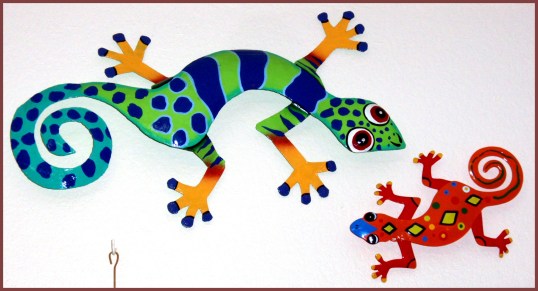
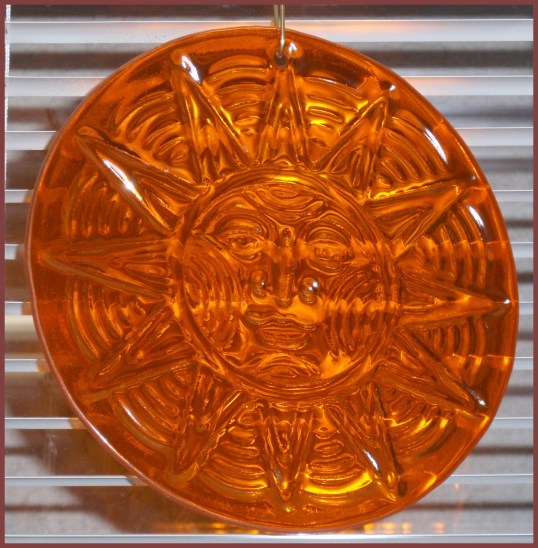
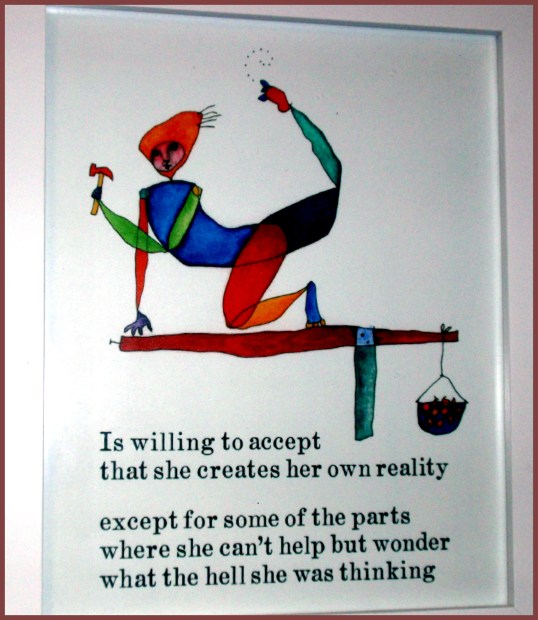
One cold, dark winter afternoon when the temperature never rose above freezing all day and I felt trapped inside my office in front of my computer, I looked around the room at all the bright things I’ve put here.

I won’t go so far as to say say my world is full of poetry right now, but there’s a hint of its brightness here and there.

Butterfly

Butterfly

Lizards

Lizards

Suncatcher

Suncatcher

Tiger

Tiger

Mandala

Mandala

Vase (underwater upside down)

Vase (underwater upside down)

Reality (ala Brian Andreas)

Reality (ala Brian Andreas)

Good Advice!

Good Advice!

A bit of brightness landed on that one. Happy Saturday!

hope for the new year

Dancer/choreographer Lionel Hun performed this exquisite dance in Macau shortly after the Tohoku earthquake and tsunami in Japan. The credits say “For Japan.” Let’s have it be “For Everyone Everywhere.”


NOTE: As of January 2013, give me a daisy will publish new posts every Tuesday and Saturday, instead of every Tuesday, Thursday, and Saturday.

Please check out my new blog, Farther to Go: Creating Meaning in Midlife &  Beyond if you are so inclined.

Post Navigation