give me a daisy

~ ~ ~ ~ read ~ write ~ look ~ listen ~ create

Archive for the month “March, 2013”

accepting the Very Inspiring Blogger award

blogaward

Thank you, Debbie and Container Chroniclesfor nominating me for the Very Inspiring Blogger Award. (I can hardly contain myself!) But seriously, I’m really pleased and grateful for the nomination and to be able to share it with other bloggers.

there must be rules

  1. Display the award logo on your blog.
  2. Link back to the person who nominated you.
  3. State 7 things about yourself.
  4. Nominate 15 other bloggers for this award and link to them.
  5. Notify those bloggers of the nomination and the award’s requirements.

there must be 7 things about me

  1. I named my cat Naima after the ballad John Coltrane wrote–and named–for his first wife (it’s on the album Giant Steps). Naima means “tranquil,” which is probably why my cat refuses to answer to it.
  2. The first time I tried to leave home, I was 3. Then I laid low till kindergarten before making another attempt to escape.
  3. My favorite foods are raspberries, ginger, and cilantro. Coffee is essential. Dark chocolate makes everything better.
  4. For a few years, I was the firm administrator for an accounting firm. I created the Accounting Academy Awards to get us all through tax season.
  5. I’ve been writing and telling stories in one form or another from very early on. In my pre-teens, for example, I wrote over a hundred plays on lined loose leaf paper. Each completed “work” went into its own card stock report cover with the title handwritten in the little rectangle on the front.
  6. In the 70s, I had a job where I went to work barefoot one day, and the only question anyone asked me was, “Aren’t your feet cold?”
  7. If I only had one day left to live, I’d want to spend it hiking in Pt. Reyes National Seashore.

there must be sharing!

Here are 15 fellow bloggers I’m nominating for this award. Please check them out and see for yourself how good they are.

  1. Sorting it Out
  2. LUGGAGE Lady
  3. Meaningful Life
  4. Under the Blue Door
  5. Xenogirl
  6. K.L. Wightman
  7. Internal Evolution
  8. It Started with a Quote
  9. Courage 2 Create
  10. The Running Father Blog
  11. My Life in Color
  12. Flashlight City Blues
  13. Hege Nabo
  14. The Happsters
  15. Land of Enchantment Blog

Thank you again, Debbie, and thank all of you inspiring bloggers for doing what you do. Being able to peek into so many different worlds makes my world that much richer!

turn it up!

The Band, Hamburg, May 1971. Left to right: Ri...

The Band, Hamburg, May 1971. Left to right: Rick Danko, Levon Helm and Richard Manuel. (Photo credit: Wikipedia)

The Band was part of the background music of my life for a while, but at the time I couldn’t have distinguished one musician from another. I wasn’t really paying attention until Robbie Robertson released his first solo album, Robbie Robertson, in 1987. Loved it the first time I heard the first track; love it still–especially the mesmerizing “Somewhere Down the Crazy River.”

Much later I came to appreciate Rick Danko. His voice is the one in my head when I think of The Band. Danko recorded this beautiful acoustic version of “When You Awake” in 2009. It seems even more moving and powerful than The Band’s version.

One of the songs Levon Helm is best known for is “The Weight.” There are a lot of versions of this song, but this one from the documentary The Last Waltz is so good.

Van the man

The Last Waltz has been called the best music documentary ever by some critics. I haven’t seen them all, but it’s definitely my favorite. All the music is fantastic, but the performance that tops the rest is Van Morrison doing “Caravan.” It’s worth watching the whole thing just to get to those five or six minutes. It’s too bad there’s no video available, but this audio gives a sense of the electricity in the auditorium. Turn it up! Little bit louder. Radio!

And then, of course, when we did “Caravan,” which was something that we really just wanted to play together, and I wanted to play some guitar on, and we wanted to do that. And we did this. And we had the horn section and the whole thing, and the way the song built and it built and it built. All of a sudden, at the end, when Van starts kicking his leg up in the air, we were like, “What’s happening here? This is the most wonderful out of control I’ve ever seen him.” And it was just magical, you know, just that whole song, and the performance of that. When we were finished playing that song, when I turned around, you know, to the other guys in the band, and I was like, “Okay,” you know? We were just feeling so good at that moment.

— Robbie Robertson, VH-1 interview on the making of The Last Waltz.

masks

OLYMPUS DIGITAL CAMERA

“I would but find what’s there to find,
Love or deceit.”
“It was the mask engaged your mind,
And after set your heart to beat,
Not what’s behind.”
–from The Mask, William Butler Yeats

Masks have always fascinated me. People have been making and wearing them for thousands of years. The earliest ones found are over 9,000 years old.

The only piece of art I’ve ever regretted not buying was a teal colored plaster mask of a woman’s face on display in a booth at the Sausalito Art Festival many years ago. The mini installation above consists of a leaf-shaped fan I’ve been carting around for years, an elaborate dream catcher my partner and I got from an artist at the downtown farmers’ market in San Rafael one summer evening, and a paper mache mask he made of the upper part of his face before I met him (and before his deviated septum was corrected).

I’ve always thought it would be interesting to make a mask from a mold of my own face. For a while, I knew of a local artist who taught mask-making classes, but I never followed through. I might yet do it, though. I found these detailed instructions on how to make a paper mache mask. It’s a messy process and seems like the kind of thing that would be more fun to do in a group.

Beyond being fun, making a mask can be a more meaningful, even a transformational, experience:

Artists use a wide range of materials for the masks they make. Spokane artist Annie Libertini makes gorgeous leather masks. Click the link below to check out how she does it and what her creations look like.

Watch Transformational Masks on PBS. See more from Northwest Profiles.

Julie

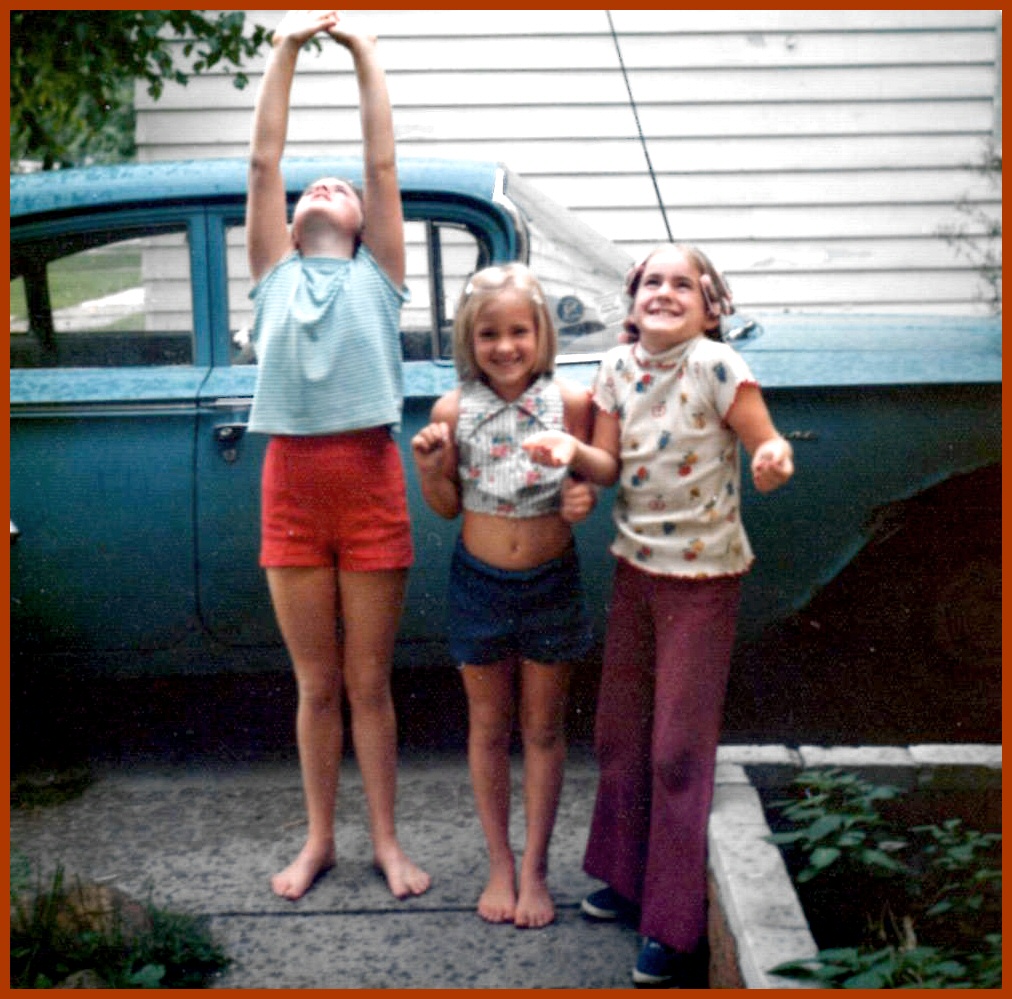
JulieJulie, the youngest of Jim’s girls, was everyone’s pet, easygoing and funny. She was also the girl of many nicknames: Jules to most, Goldie to her dad, and later Wobbles, after one of her sisters teased her about not being able to walk straight. Julie thought that was about the most hilarious word she’d ever heard. When she wrote it down she spelled it W-A-B-L-S, which is exactly how I spelled it—capital letters and all—when I embroidered it in multi-colored floss on a white sweatshirt she wore with pride.

From the time she was a baby, her older sisters and a housekeeper were her primary maternal figures. Somehow she came out perfect, a sunny, energetic child with a great sense of humor who brightened up the room for everyone in it.

night after Julie

Moving in a dream…
I…
Tripping
Through the steamy night…
Blue-gray mystic…
Soft rain dust…
Floating…
Turning inside out…
Touching air
And water
And blonde
And blue-grey child
Touching…
Me.

Julie

Julie2

Julie was a spunky child with love and affection to spare. She seems to have been born equipped to roll with the punches, to take it all in stride. I hope she’s still all that.

Lainie

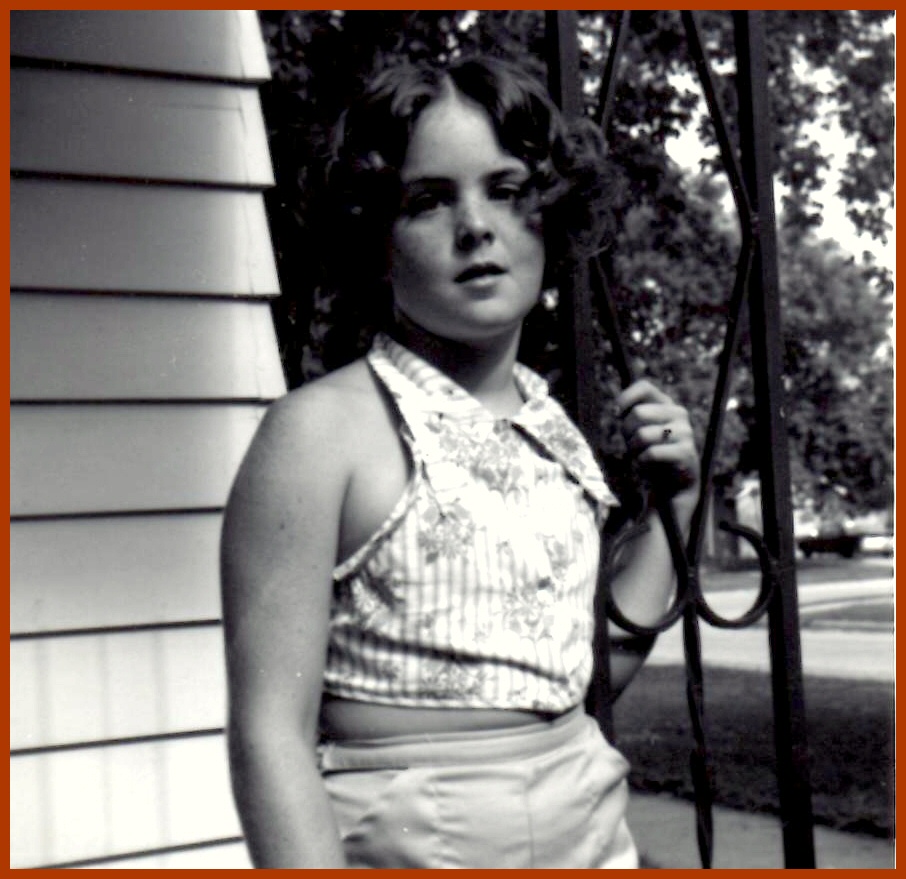
Lainie3Lainie, the middle of the three girls, was quieter than the other two, both perceptive and enigmatic–and with an air of self-sufficiency. When she spent time with me, I never had to make any special arrangements or go out of my way to entertain her. She liked hanging out with me and was more than content to tag along when I went to the dry cleaner or picked up a few groceries.

Sometimes the two of us spent an entire evening sitting in separate chairs, reading our separate books, barely talking to each other but always connected.  What she wanted was the experience of normal, everyday life with me in it. Nothing special. A few times she called me “Mom,” in a small, hopeful whisper that nearly broke my heart.

whose child?

I have names for you
and metaphors.

Mermaid.
Lily Maid of Astolot.
Elaine.

I look at you and wonder:
How’d the wheat get in your hair?
and the river in your eyes?
Wildflower,
What contents you
to be domesticated so?
Now ballerina
and assistant cook.
Do you include in these
mysterious ingredients:
ritual dances and magic herbs,
delicate sorcery
to cast your spells?

Fairy Princess,
in exile from your majesty,
You look at me
and only want to call me “Mother.”

It’s so simple.
Why is it so impossible to be.

Lainie1

Lainie2

This giggling girl was wise beyond her young years. Wherever she is, I hope she’s happy and has someone who makes her laugh.

P.S.: She really did own more than one shirt, although for some reason she’s wearing the same one in most of the photos I took of her.

Next time: Julie

Leane

LeaneLeane was the oldest of Jim’s three girls and also the biggest handful. A nonstop talker, she needed to have someone’s constant attention. That was why I initially started spending time with each of them separately, to give all of them some one-on-one time.

She was the only one of the three who remembered and missed her mother. How do you get over that kind of betrayal? But whenever she wanted to talk about her, it seemed like no one else in the family was interested. Julie was too young to remember her mother and Lainie, surprisingly pragmatic for her age–or maybe not–had written her off.

Since Leane was curious about sex, I bought a couple of age-appropriate books on the subject and during one of her overnights we spent an evening sitting on my bed looking at the pictures and talking about the strange ways men and women have of relating to each other.

wind chimes

Listen:
These chimes are made of glass.
They sparkle in the sun
And in the wind they make a joyful noise.

Do you know
The joy you reach for so eagerly
Can illuminate your life
Like those prisms of glass,
Or smash into a thousand pieces
Sharper and more painful
Than any shards of glass.

You are a reckless child.

Are you too old for lullabies?
Is that why
I try to lull you instead
With these disembodied words?
Can I hypnotize you into believing
in the natural superiority of reason
in my adult view of things
that everything is all right
and down is up?

So many words.

They circle around your pain
Trying to tell you it doesn’t hurt.
Trying to tell you what to be
Instead of listening to who you are.

Who are you?
Knowledge is a wound sometimes
And people are afraid.
You are.
I am.
But we have chosen each other,
And I can look at you now
And listen to you:
All of you there is
And all there is to come.

Who are you?
Child of love and fear
Wind howling in the night
Love burning a fever
Need tracing a pattern of tears and hopes
on face and pillow,
Daughter of my heart and soul,
I know you–
more than it is easy to know
but not more than I want to know.
You can look at yourself in my eyes
and see someone who is loved.

I gave the poem to Leane. She was old enough. She said she hadn’t known I felt that way about her.

Leane1Leane2Lovely, lovely girl! I hope the world has treated her better since that rocky start it gave her.

Next time: Lainie

Jim’s girls

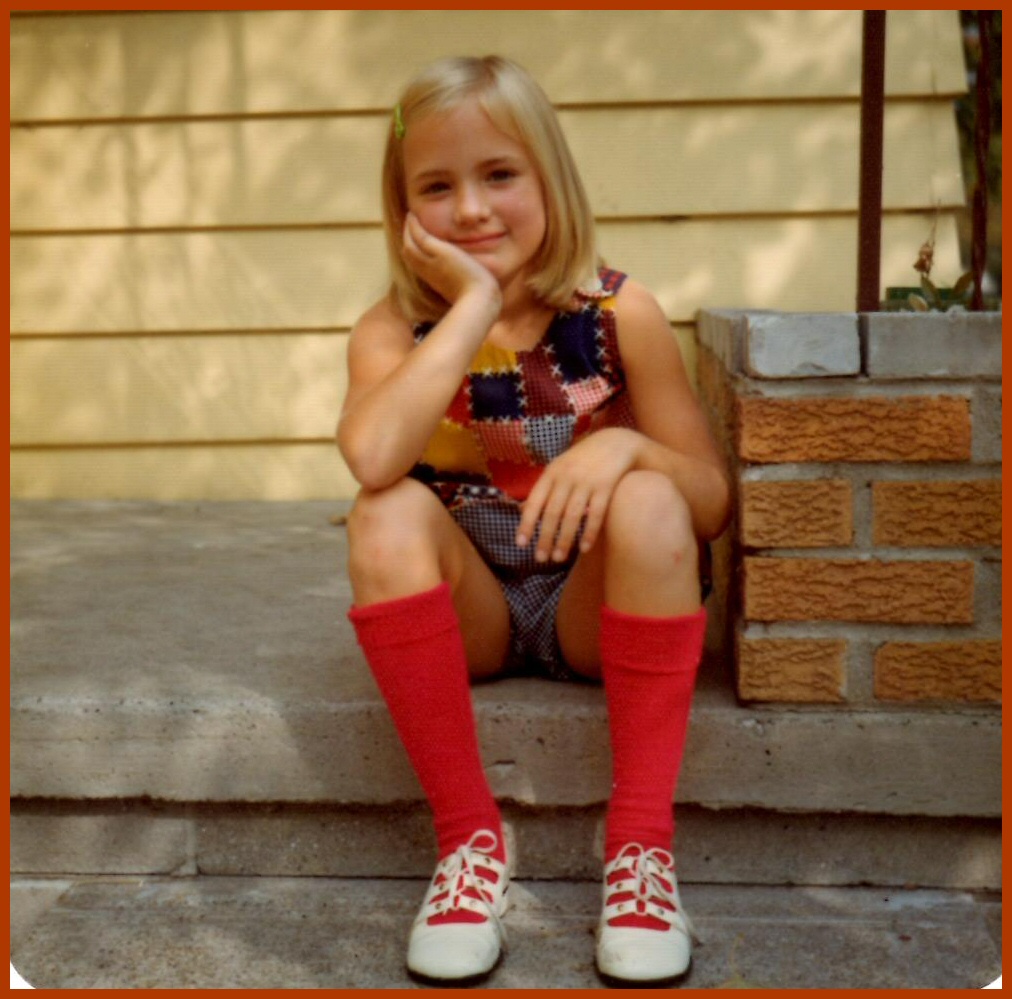
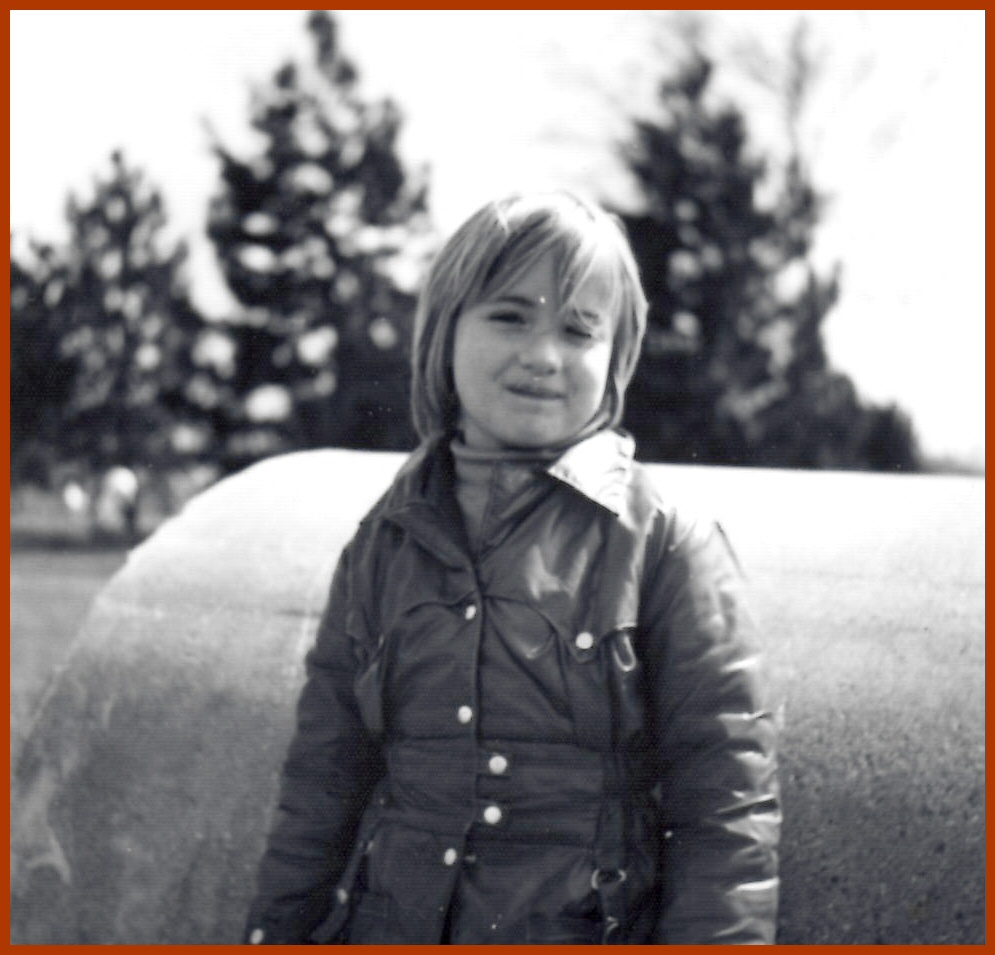
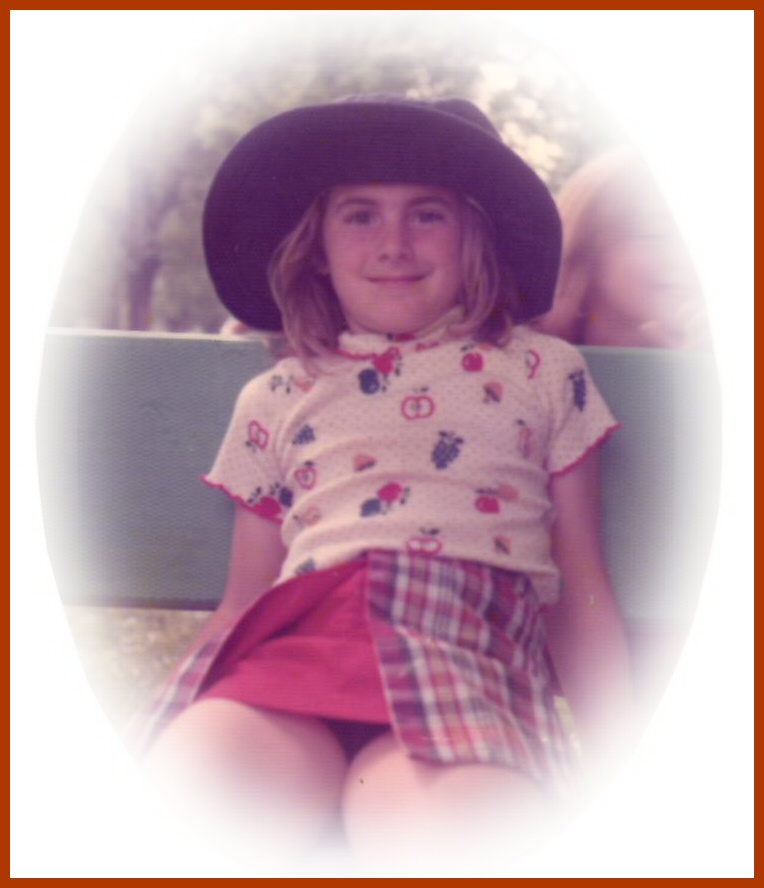
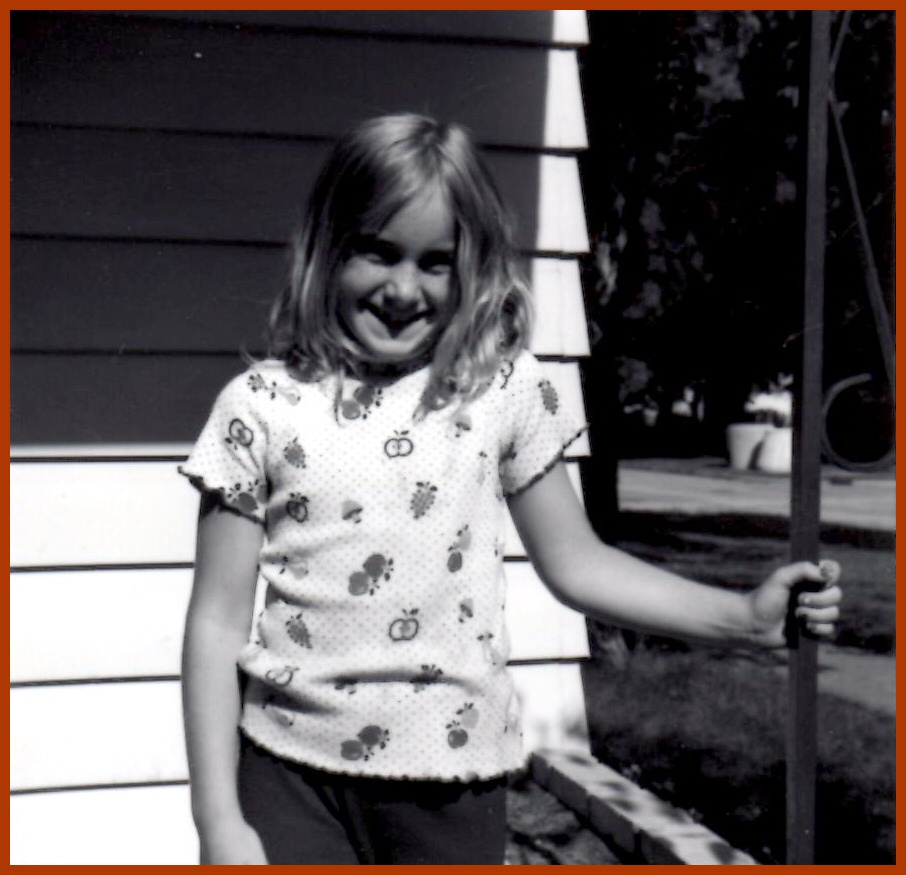
Leane, Julie, LainieJim was an engineer I dated for the better part of a year. He had three daughters who were, when I first met them, 12 (Leane), 10 (Lainie), and 5 (Julie). His wife had gotten custody five years earlier when they divorced. That’s right; Julie—or Jules, as she was called—was an infant. But instead of taking the girls with her to New York, as she’d promised, she left them with Jim, moved to Florida, remarried, and started a whole new family.

Who could–who would–do something like that?

For a while I spent my weekends at their house, more often than not the one who woke during the night at the slightest sound of coughing or of sleepy, stumbling feet. During the day, I helped them on and off with their snowsuits in the winter and fixed dinner while Jim worked on cars in the backyard with his buddies. It was a cozy domestic arrangement that didn’t last long. I tried to capture Jim in this poem:

aura

Silver.
Softened sometimes
by nightlight:
crystalline
and lustrous.
On rare days
catching the sunlight
and shining.
But hardened mostly,
into metal flakes,
chrome and steel
like your cars.

When we had the breakup discussion, I told him somewhat defiantly that I wouldn’t give up the girls. To his credit, he said, “Of course not,” and we arranged a visitation schedule. He worked in the city where I shared a house with my friend Debbie. Every week during that summer, he brought one of the girls with him in the morning and dropped her off at our house. After work the following day, he picked her up. When I was feeling reckless, I asked him to bring all three.

New School ClothesI left their lives too soon, too, but before I moved from Michigan to California, I took each one shopping for school clothes and shoes. The photo on the right was taken as we were about to head off for a music concert late in the summer. I love how they look like they’re in a police line-up. The day I left, Debbie drove me to the airport and brought Leane and Lainie along to see me off. I remember it being a muggy, gray November day. Julie didn’t come. She said she didn’t want to watch me go. But I gave them a big stuffed animal, a gift from an old boyfriend. The girls named it “Gor,” short for Gordon, the ex. They took turns sleeping with and fighting over it.

I know because they told stories on each other in the cards and letters they sent during the year after I left.  I also saw them when I went home for a visit about 14 months later. But eventually we moved on–or so it seemed at the time. I’ve always hoped I didn’t do them more harm than good by getting so close to them and then leaving. I know I was the lucky one to have had all that time with them.

Next time: Leane

stormy weather

Two poems about the sometimes rough weather of relationships, one written by my partner and the other written by me, before we knew each other.

weather man

Storm

I’m a storm center. Still,
Sun broke through, warming her
Now and again. Then I’d think,
She is bound to get used to
my weather.

Always, though, cloudbanks
Returned to us, scudding ashore
Like a black threat. We stood
At the seawall, screaming
into the wind.

She said it was nothing to her
If I wanted to waste my days
Gathering darkness, but
She needed light, craved
spaciousness, clarity.

She was tired of grayness
Clinging to edges, fogging
Our seasons. Winter forever:
Words freezing, losing their
power to move.

I told her
There’s nothing that changes
as fast as the weather.

“Not yours,” she said, turning
To stare out
the window.

She left unexpectedly. I was
Astounded; the day had been fine.
I ran where I thought she had gone to.
“Look! Look!” I shouted.

“The sun is shining! The sun
is shining!”

schism

Pose de 90 secondes. Lightnings. 90 seconds ex...

Lightning struck
the room,
Illuminating
our sins,
splitting us
into separate pieces
and sending us
to different places:
You to purgatory
and me to hell,
although it may only be
a trick of the mind.

But then why
am I
still burning?

And why
do we speak
to each other
in foreign tongues?

I can’t hear you
over the howling
of the wind
and I wonder
if you can see
the rain
washing away
the traces.

If it rains
long enough,
will it put out
the fire
and bring me
back to earth?

just driving

Dead End Sign

Dead End (Photo credit: Susanne Davidson)

I’m driving my car alone at night. It’s very dark: black like midnight. There’s no one else, no other cars, no other people. The darkness is palpable. It has a texture. Smooth, but not exactly soft. I think of wool, but that’s not exactly it. Let it go.

I have no sense of what I’m wearing or the feel of the air against my skin. All I’m aware of is driving, moving, the motion of the car—and the darkness, which is an envelope that contains me.

I’m driving along an empty road, alone in the middle of the night. I find it odd now, but I used to do it all the time in Michigan. I was much younger then. I often drove home late, late and alone, on River Road or I-75. It was unremarkable, comfortable, familiar—although sometimes bittersweet, depending on where I had been. And who I had been with.

This is a different empty road I’m driving on, in West Marin, maybe near Olema, but I know it very well. I have no specific destination, no particular sense of purpose. Then I come to a stop sign where the road dead-ends, and I have to turn. I have to make a choice. Which way should I go, left or right? I should know which way because I’ve been on this road many times before. Why don’t I know which way to turn?

Consternation. Even though it’s the middle of the night and there’s no traffic, no one behind me, no one with me, and I don’t need to be anywhere by any particular time, I feel a sense of urgency about deciding. I must choose. I must choose now.

I choose to turn left. I don’t know why. I begin driving down the road on the left and soon find myself in an unfamiliar place. The road goes up and down hills, twists and turns, and runs between buildings. The buildings are brick, the size of houses or a little larger, all the same pale color. The area is deserted, but the pattern of streets and buildings is very busy.

I now know I have made the wrong choice. I decide to retrace my route back to the point of choosing and choose again. It’s surprisingly easy to do it, to go backward. Even though I’ve made the wrong choice, I haven’t gotten lost. I can find my way back.

How have I recognized that I’m in the wrong place? Is it just the strangeness of the surroundings? I don’t know. When I return to the point where I turned left, I continue traveling straight. Now I feel that I’m moving in the right direction. It feels like alignment, balance, correctness—not all that remarkable. It’s the absence of that feeling that was noticeable and even disturbing.

Night Sky, Moon

Night Sky, Moon (Photo credit: thisreidwrites)

Now I’m driving on a country road that curves gently here and there. I’m still the only one traveling on it. I can’t really see very much, but I know there are trees and hills alongside the road. I feel that I know where I am. As I come around a curve, I look up and see the moon in the dark sky. It’s a half or three-quarter moon, and I can see both the dark and the light parts—a complete circle of moon surrounded by a thin ring of light. It is very large, three or four times larger than normal for this late at night. This moon is so compelling. I stare at it for several seconds, caught by it, surprised by it. Why am I seeing it? What does it mean?

When I look back at the road, I see only black in front of me. I blink my eyes a few times to clear them, but nothing happens. Now I’m driving down this country road, alone, in the middle of the night, and I’m blind. I don’t slow down. I don’t veer off the road. I just keep driving.

This is dangerous, but I’m not afraid. I still don’t slow down. I have been blinded by the moon. Blinded by the light of the moon, and driving, driving, driving in the right direction. There’s no one else in my midnight, moonstruck world, and nowhere I need to be. I’m just driving.

Post Navigation