give me a daisy

~ ~ ~ ~ read ~ write ~ look ~ listen ~ create

Archive for the category “Music”

‘tis the season to be buoyant

buoyant morning

buoyant morning (Photo credit: Pedro Moura Pinheiro)

With the arrival of the winter solstice last week, I needed to choose a new keyword for the next three months. The first (and last) time I chose a keyword for a season, I did it without putting much thought into it. Velocity came to me immediately, and so did the accompanying theme song, Glad Tidings by Van Morrison. Somewhere along the way, I realized that focusing on velocity without having first determined my direction was like sending a driverless race-car speeding 100+ miles per hour along a track. Nothing good was likely to come of it. So I paused to set a couple of goals.

This time, I wasn’t quite so hasty. I discarded my first choice of keyword, focus, when I realized focus is one of those things that repeatedly gets me into trouble. I don’t usually have difficulty focusing. On the contrary, what I have difficulty with is stepping back and loosening the reins of my focus. Sometimes circumstances change, you know? But I’m nothing if not persistent, so it often takes me a while to notice and then to back off or switch gears.

What I came up with for my winter keyword is buoyant. If I haven’t mentioned it yet, I really dislike winter. I dislike the cold temperatures, the noisy furnace, the layers of clothing, the short days, the gray skies, and the snow (when we get it). Winter feels heavy and oppressive to me. If I could wear shorts, sandals, and a T-shirt year around, I would. It takes temperatures hovering around 100 degrees before I comment on the heat. I’ve hiked the Sandia foothills in the mid-afternoon in the mid-90s. You just have to slather on the sunscreen, wear a hat, take plenty of water, and try not to run a marathon out there.

So the three months between December 21st and March 21st are my least favorite of the year—a trial to get through. This year I’m going to try a different tactic by attempting to lighten up, loosen up, and be a little more cheerful. Along with cheerful, lively, and sprightly, a few other synonyms for buoyant are:

Bright
Sunny
Animated
Genial
Blithe
Light-hearted

All good stuff, but it gets even better because buoyant also means:

Expanding
Developing
Strong
Thriving
Vigorous

Since I’m working on a new venture right now, this sense of the word buoyant is ideal for that, too. The third definition of buoyant refers to being light and able to float on water. Large bodies of water and I are not friends, so although I love this concept, it’s a little edgy for me. But that’s OK; a little edginess never hurt anyone. And light is the opposite of heavy, which is good.

now i know how it feels
to have wings on my heels

The search for a theme song also took longer this time than it did before. A lot of songs came close, but none of them hit exactly the right note. Then I came across this one by, of all people, the Moody Blues, from To Our Children’s Children, and it’s perfect.


Floating free as a bird
Sixty foot leaps, it’s so absurd
From up here you should see the view
Such a lot of space for me and you
Oh, you’ll like it
Gliding around, get your feet off the ground
Oh, you’ll like it
Do as you please with so much ease
Now I know how it feels
To have wings on my heels

I confess to having owned several Moody Blues albums way back when, but I don’t think I had this one.  And I probably wouldn’t have chosen this song for one of my playlists in the normal course of events. But the purpose of choosing a keyword is to aim my attention in a different direction, to consider things from a different perspective, and to get out of my usual mindset. In this case, to be more buoyant!

Do you have a keyword for winter? If so, please share it.

CDZA: collective cadenza of crazy good music

CDZA is composed of many musicians, some from Julliard School of Music and other music schools such as Manhattan School of Music, Berklee College of Music, and Brooklyn College of Music, along with several Broadway singers. For the past nine months they have been working on a project to create “musical video experiments.” These are some of my favorite results. But there are many more, so check out their website.

What a Wonderful World as you’ve not heard it before:

It’s too late to order fries:

Great singer–and I love the guy in the Elton John glasses:

A little sad; a lot funny:

paradise?

This is another gorgeous animation short, mixed media this time, by Ishu Patel, titled “Paradise.” The music is by Zamfir.

When I saw it, it reminded me of the creation story I wrote over a dozen years ago for a mythology class, very loosely based on Buddhism and quantum physics’ theory of the unified field.

the yearning of desire

In the beginning, All was One, and the One was nameless and without form. Within the One existed All Things. But there were no distinctions within the One; no thing was separate from any other thing. Although countless aeons passed, there was no experience within the One of the passage of time. Gradually, from within the center of the One, arose the beginning of Desire. At first Desire was like a small bubble rising to the surface of a perfectly still lake. At first Desire was only the softest whisper of the wind. Desire wanted to give form to the formless and to name the nameless. Desire yearned for forms to touch and to surrender to.

More aeons passed, and Desire continued to grow within the One. Desire pulsed within the center of the One, louder and stronger, and the pulsing of Desire gave form to Spirit, that which inhabits all and everything. Spirit allowed himself to be inspired by Desire and to contemplate all the possibilities that form could take. Spirit saw that formlessness needed form, just as form needs formlessness. Spirit saw that formlessness needed form to complete itself. Spirit then dreamed the dream of the universe taking form, from its beginning to its end, which was not really an end but only a return to formlessness. As Spirit dreamed the dream of creation, Desire allowed herself to be infused with Spirit, and as she did, she took the shape of a large, graceful bird, covered in the palest of green iridescent feathers. Spirit was the air that she breathed.

Spirit longed for the forms that he had dreamed of. And Spirit longed to be inhaled by Desire, just as Desire longed to breathe Spirit. With each inhalation of Spirit, Desire flapped her pale wings. As the flapping of her wings increased, the colors of her feathers deepened into verdigris and copper, turquoise and silver, aqua and gold. She spread her wings and flew in a wide, lazy arc, and she sang the purest, most exquisite songs, whose haunting echoes trailed behind her. She coasted on the currents of air that were Spirit.

As Desire breathed in more of Spirit, she too began to visualize the forms that Spirit had dreamed of. As her yearning increased, so did the flapping of her wings. Her tail feathers grew longer and their color changed from pale green to deep red. She swooped and glided through Spirit, inhaling more and more of his visions. The feathers of her body turned crimson and saffron. Desire felt something growing inside her, in the same place where her yearning had first begun its delicate pulsing so many aeons ago. She flapped her wings again and soared upward. An indigo band formed around her neck. Her singing became louder, more rhythmic, and more intense. It filled the entire universe with its insistent, rapturous vibrations. Spirit was enthralled by the songs of Desire and continued to fill her with the countless forms he had dreamed of.

Desire was full of a longing so powerful that she thought it could never be filled. The feathers of her head changed to amethyst and violet, and a royal purple crest took shape along the top and back. She opened her mouth to cry out but no sounds of any kind emerged, neither cry nor song. Instead, when she opened her mouth the countless forms of the universe began to spill out into the air, into Spirit. Each time she opened her mouth more forms issued forth until everything that Spirit dreamed had been given its form. Spirit was satisfied because he was everywhere, inhabiting all of the forms of the universe. But Desire, without whom no form could exist, could not touch them, could not fully satisfy her yearning. It is the nature of Desire to remain unfulfilled. And we, too, who were given birth through Desire, know that no matter what we have, something is always missing. Though Spirit fills us and gives us joy, there is a place in our hearts that it cannot touch. Desire is the permanent longing in our hearts for home, for the One, for formlessness.

all we have here is sky

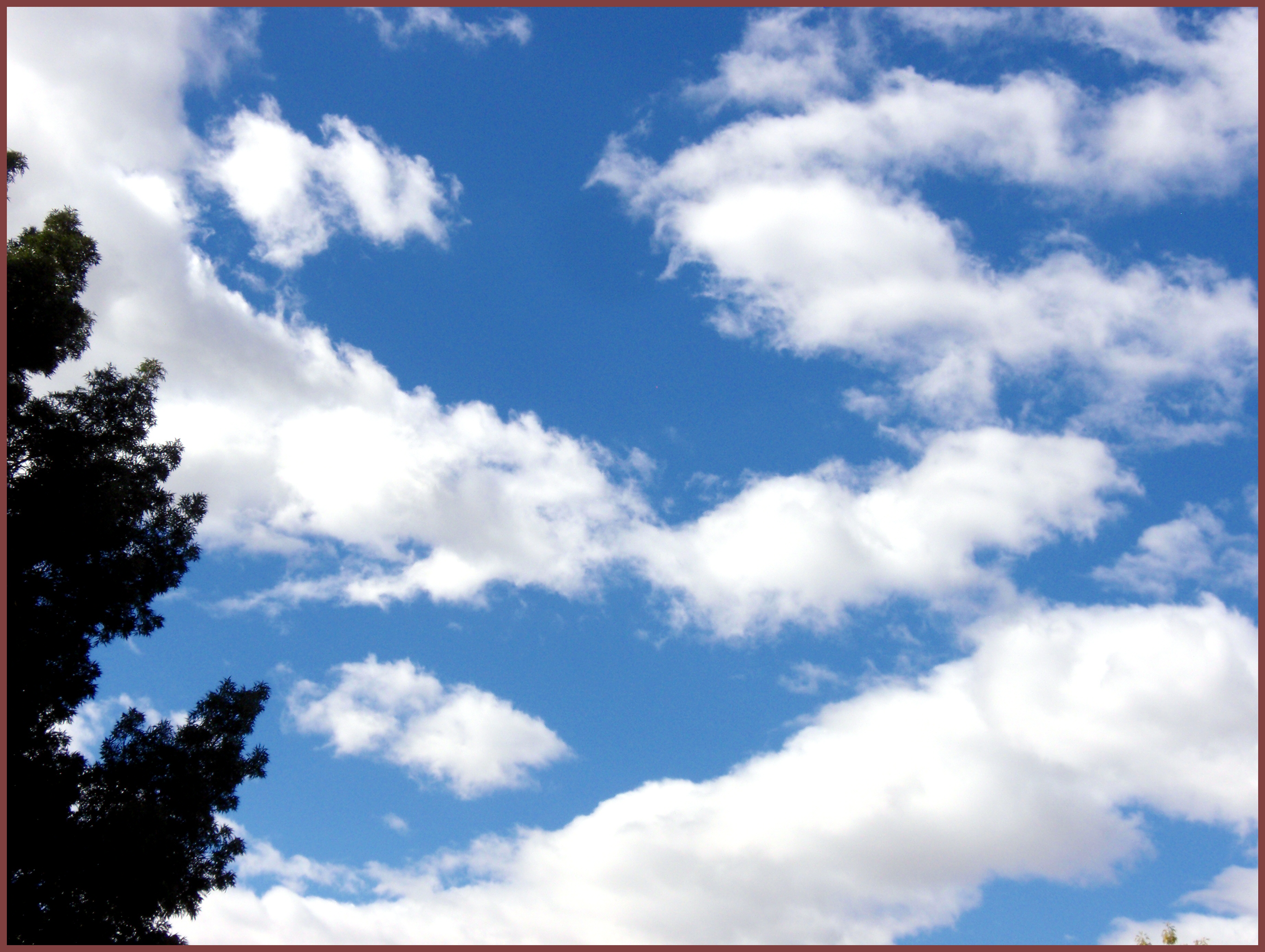
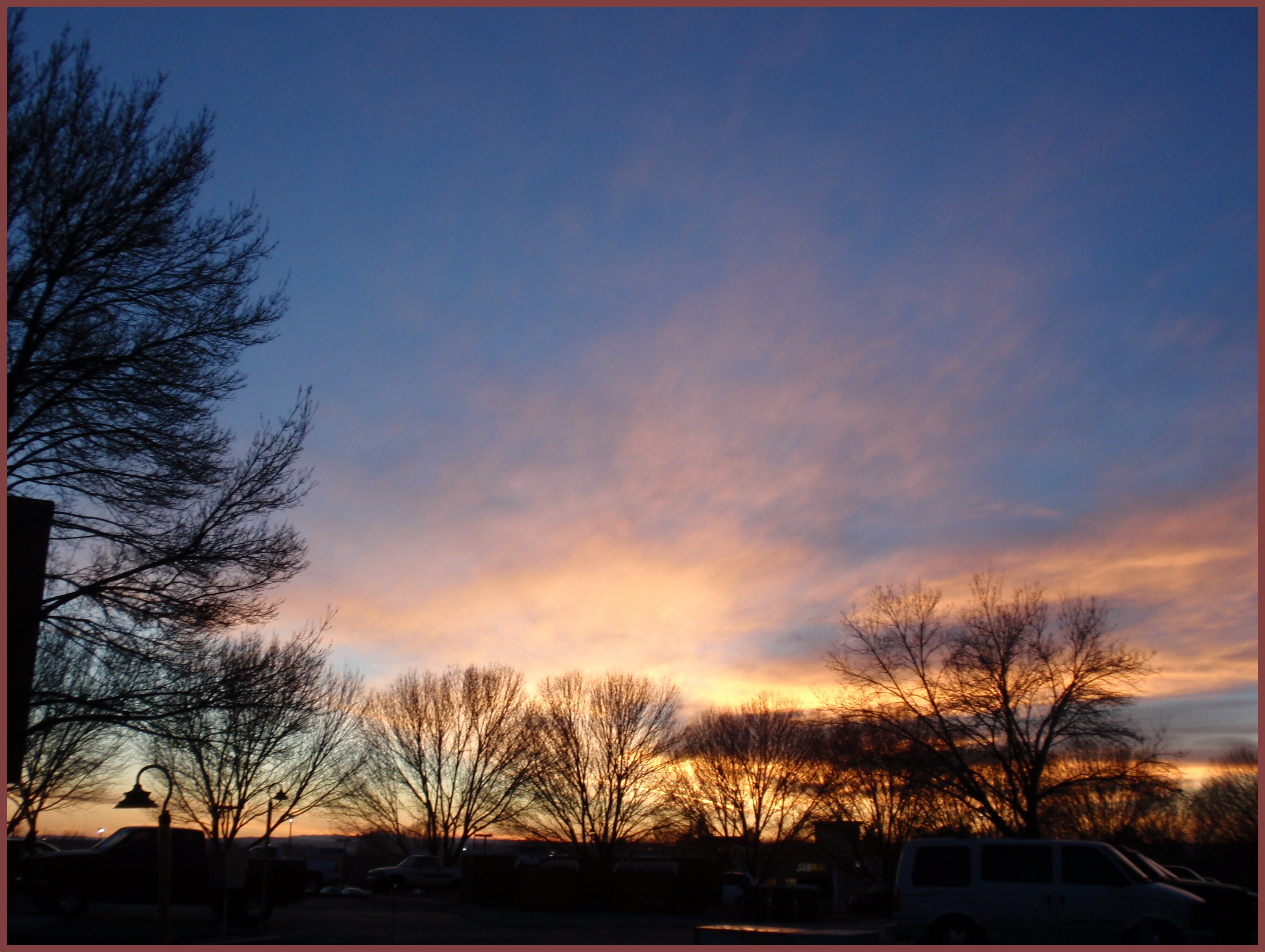
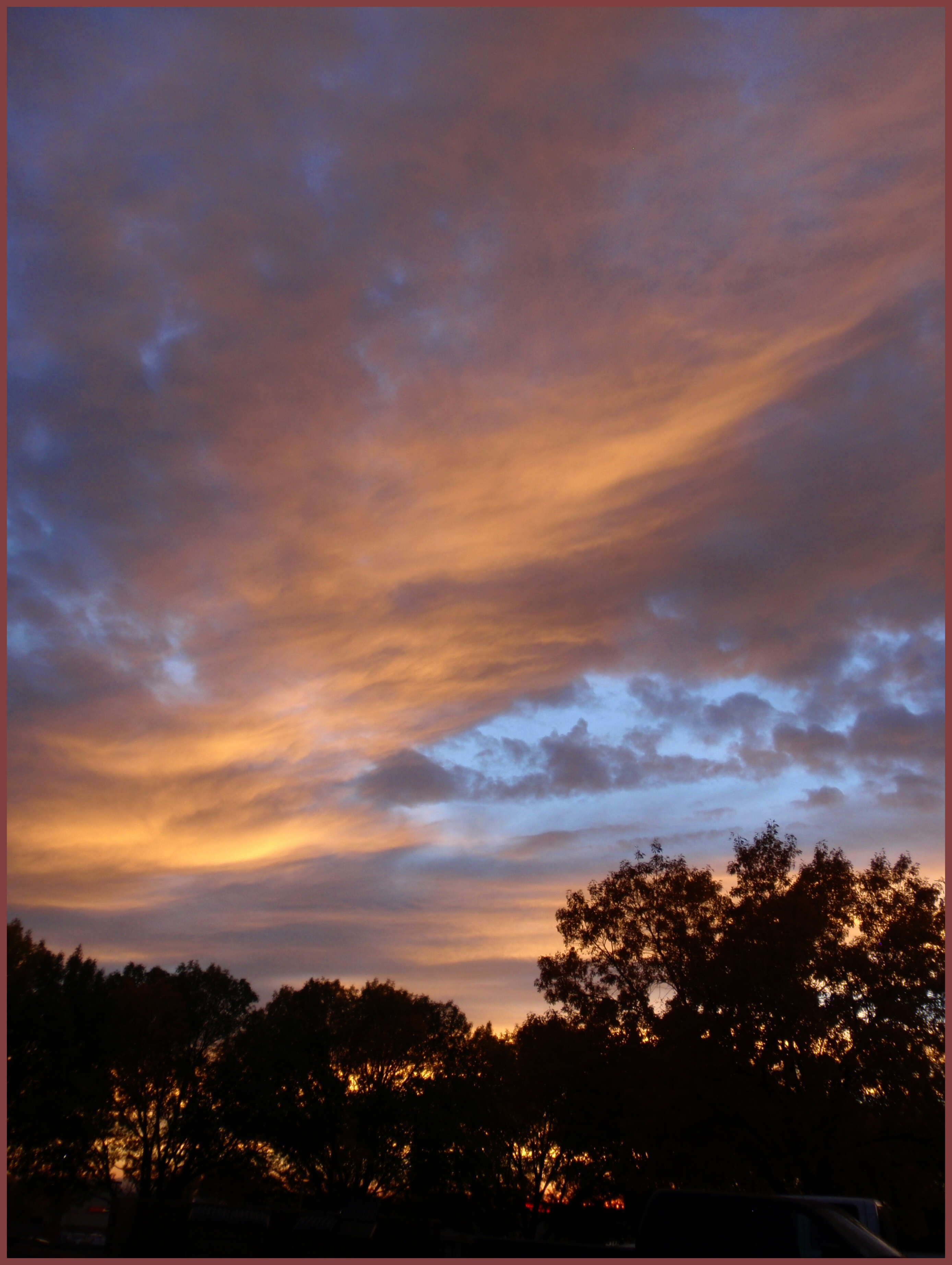
New Mexico is called The Land of Enchantment. And it truly is. I never tire of the changing light and color and cloud configurations. I keep my camera near the front door because all I have to do is step outside to get a hit of wonder.

This is the sky at sunset a couple of weeks ago:

Some zigzag clouds in October:

The liquid amber tree across the street:

The sun setting behind bare trees:

Another one. (Couldn’t decide which photo to use.)

Early November sky:

The pale moon in October, not quite full:

I feel fortunate to live in this place. Fortunate to have a camera. And fortunate to have a place to share these pictures. I also feel fortunate to have come across this loopy but totally irresistible video of Jane Siberry. Who remembers this?

reggae in Hopiland

Panoramic view of Hopi Reservation from Arizon...

I’ve been a huge Bob Marley fan for quite a while, which is why I made the protagonist of my novel-in-progress INDIAN SAM an even bigger Marley fan. The novel is set in the Southwest, and while I was doing some research a couple of years ago, I discovered a musical convergence I hadn’t expected to find.

It turns out that the Hopi Indians embraced Bob Marley back in the 1970s and are still huge reggae fans.

They sing about oppression, and we feel that here. And they sing about peace and unity in the world, which is what our religion teaches us. But it’s the beat, too. It has the same feel as our tribal drumming.

Jennifer Joseph, Hopi painter and graphic artist

Marley reportedly wanted to visit the Hopi reservation in Arizona, but he died before he had the chance to do it. Freddie McGregor, unofficially the “Ambassador of Reggae,” was the first reggae musician to play a gig on the reservation. He returned to perform there at least five times.

In the 20 years preceding 2003, there were nearly 60 reggae concerts on the reservation featuring groups such as Black Uhuru, Third World, Burning Spear, and Steel Pulse.

Eventually a homegrown reggae artist emerged in the form of Hopi/Diné singer Casper Loma-Da-Wa, who listened to reggae on the radio while helping his grandfather in their cornfields when he was growing up. He has released several CDs, including Honor the People, which has a lot of songs I really like, including Ideal, Last Train (to Hopiland), Love Life, and this one, Brother Leonard (Set Him Free) dedicated to Leonard Peltier.

In this video produced by the Culture Collective, Casper Loma-Da-Wa talks about his music:

The Hopi reservation is just about as far out of the way as you can get, so it would have been likelier for the Hopi to have missed the emergence of reggae music altogether. That reggae not only made it onto the reservation, but connected in such a deep and profound way with the Hopi audience who received it is pretty amazing. I think Bob Marley would be gratified to know how much impact his music continues to have in some of the most unexpected places.

Related article:

all is not lost

Found on Radiolab. Wow!


music of poetry

Poet Dorothea Lasky said:

The music of poetry is a delight for the mind.

And when it’s read out loud—or set to music and sung—it’s also a great delight to the ear.

i carry your heart with me

Poem by e.e. cummings/performed by Michael Hedges (with David Crosby and Graham Nash singing harmony) from the album Taproot. Cummings is my favorite poet and Hedges is a wonderful musician.

i carry your heart with me(i carry it in
my heart)i am never without it(anywhere
i go you go, my dear;and whatever is done
by only me is your doing,my darling)
i fear
no fate(for you are my fate,my sweet)i want
no world(for beautiful you are my world,my true)
and it’s you are whatever a moon has always meant
and whatever a sun will always sing is you

here is the deepest secret nobody knows
(here is the root of the root and the bud of the bud
and the sky of the sky of a tree called life;which grows
higher than soul can hope or mind can hide)
and this is the wonder that’s keeping the stars apart

i carry your heart with me(i carry it in my heart)

adventures of Isabel

Poem by Ogden Nash/performed by Natalie Merchant from the album Leave Your Sleep. I love the energy, the arrangement, the words, Merchant’s voice…everything! It’s my favorite tune on the album.

Isabel met an enormous bear

Isabel, Isabel, she didn’t care
bear was hungry, bear was ravenous
bear’s big mouth was cruel and cavernous
bear said, Isabel, glad to meet you
How do, Isabel, now I’ll eat you
Isabel, Isabel, she didn’t worry
Isabel didn’t scream or scurry
Washed her hands straightened her hair up
Then Isabel ate the bear up

Once in a night black as pitch
Isabel met a wicked old witch
witch’s face was cross and wrinkled
witch’s gums with teeth were sprinkled
Ho, ho, Isabel! old witch crowed
I’ll turn you into an ugly toad
Isabel, Isabel, didn’t worry
Isabel didn’t scream or scurry
showed no rage, showed no rancor
turned the witch into milk and drank her
Oh yeah,

Isabel!!!

Isabel met a hideous giant
Isabel so self reliant
giant was hairy, giant horrid
One eye in the middle of his forehead
morning, Isabel, giant said
I’ll grind your bones and make my bread
Isabel, Isabel, she didn’t worry
Isabel didn’t scream or scurry
nibbled on his zwieback that she fed off
When it was gone, she cut the giant’s head off

Isabel!!!

Isabel met a troublesome doctor
punched and poked till he really shocked her
doctor’s talk was of coughs and chills
doctor’s satchel bulged with pills
doctor said wow Isabel
Swallow this, it will make you well
Isabel, Isabel, didn’t worry
Isabel didn’t scream or scurry

Took those pills from the pill concocter
Then Isabel cured the doctor, yeah, oh yeah

ozymandias

And now for something completely different.

Poem by Percy Bysshe Shelley/performed by JJ Burnel (bass guitarist for the English group, the Stranglers) on the “b” side of his single, “Freddie Laker.” (Lyrics included in the video.) I confess to having once stolen a book from the public library–and it was the collected works of Percy Bysshe Shelley. I memorized this poem. I was in high school, but still, what was I thinking? What I’m thinking now is that this is actually pretty cool.

redemption songs

The story begins with Mark Johnson—a Grammy Award-winning music producer and engineer—hurrying through a crowded New York City subway. All of a sudden, he hears two monks making music, playing and singing in a language he doesn’t understand. He walks toward them and becomes part of the ad hoc audience, 200 or so people who have stopped moving toward their individual destinations in order to cluster together and listen to the music. If it hasn’t occurred to him before, it hits him now that music is a way to bring people together.

Back home in Santa Monica, Johnson is walking along a street when he hears the voice of Roger Ridley, a street musician who performs regularly on the 3rd Street Promenade. Johnson retraces his steps to ask Ridley if he can record him—and then take the song around the world to overdub the tracks of other musicians. That is the birth of “Stand By Me,” as produced by Playing For Change.

After 10 years, there’s a documentary, Playing For Change: Peace Through Music; then a CD, Playing For Change: Songs Around the World; and still later another CD, PFC2. The Playing For Change Band is formed with musicians from the U.S., the Netherlands, Zimbabwe, the Congo, Italy, and South Africa. As Johnson & company take all of these songs around the world, PFC stops along the way to develop eight music schools (in South Africa, Ghana, Nepal, Rwanda, and Mali), and then creates Playing For Change Day, an annual event to unite people through music and raise money to develop more music schools and programs.

Roger Ridley dies in November 2005. But the story hasn’t come close to ending.

~ ~ ~

You just never know the magnitude or the nature of the spark that could ignite—that could even change the world—through the simple act of creating something that’s meaningful in this moment only to you.

it’s still Newk’s time

I didn’t have much exposure to either jazz or classical music until I graduated from high school into the wider world (one town over from mine). Among the group of friends I made in college, it was almost a requirement to own certain jazz LPs, among them Quiet Nights by Miles Davis, Song for my Father by Horace Silver, and My Favorite Things by John Coltrane. They provided the backdrop for the many serious discussions we held in each other’s apartments  ’round midnight and well into the early morning.

When I got together with my partner, R.C., who was 14 years older than me and had for a time been a professional jazz musician (keyboards), we merged our music collections. His was much more extensive and diverse than mine, but those three albums were some of the few we both owned copies of.

Classical music made more of an impression on me than the jazz did, and somehow I didn’t let 30 years of living with a jazz musician impact my lack of appreciation for the music. That was his thing, not mine. When he died seven and a half years ago, I picked out a few CDs from his collection, let his son take all that he wanted, and donated the rest to the public library. I did play Kind of Blue by Miles over and over for months, but then I put it away.

Sonny Rollins

I developed my current love of modern jazz pretty much on my own several years ago by borrowing CDs from the library to listen to. After deciding who and what I liked, I built up my own modest jazz collection. I still don’t appreciate Ornette Coleman, Cecil Taylor, or (don’t strike me dead, Lord, I did purchase one of his CDs) Thelonious Monk. I dug deeper into Coltrane, added to the Miles collection, and welcomed back Oscar Peterson, the Modern Jazz Quartet, and Gerry Mulligan. I also “discovered,” among others, Art Blakey, Lester Young, Teddy Wilson, Dexter Gordon, Dizzy Gillespie, and wonder-of-wonders, tenor saxophonist Sonny Rollins. Better late than never.

saxophone colossus

Sonny Rollins is one of the minority of his peers, it seems, who not only hasn’t succumbed to drug and/or alcohol addiction or otherwise died too young, but who is also still creating, composing, and performing. At 82, he just this month performed a 90-minute set at Davies Symphony Hall for the 30th annual San Francisco Jazz Festival. A few years ago, he headlined the New Mexico Jazz Festival, and I was severely disappointed that I wasn’t able to attend. (Wherever he is, I’m sure R.C. was shaking his head over that.)

One of my favorite albums of his is Don’t Stop the Carnival, recorded live at the Great American Music Hall in San Francisco in April 1978. I was actually living there, but in complete oblivion, at the time, so I missed that, too.

Two of his best-known albums are Saxophone Colossus and The Bridge. I happen to like Sonny Side Up with Sonny Stitt and Dizzy Gillespie quite a lot, too.

His signature song is “St. Thomas,” from Saxophone Colossus:

And here’s “The Bridge,” from The Bridge:

One more: the title tune from Tenor Madness, with John Coltrane:

Everyone should have a little Sonny Rollins around for times that are already good (to make them even better) and times that are not so good (to smooth out the bumps or at least make you want to get up and move). Go, Sonny! Long may you run.

~ ~ ~

Note: Newk’s Time is the title of an album released in 1958. Rollins got the nickname because he resembled–and was once mistaken for–a major league baseball player named Donald Newcombe, whose nickname was Newk.

arts & the mind

It’s more than sad and disappointing that so many elementary and secondary schools are decreasing art programs or cutting them out altogether. It’s a cost-saving measure that hurts not only the students, but also society in general. Arts–and creativity–are not add-ons or extras. They aren’t really dispensable.

Humans have been making art, in the form of painting, drawing, and carving, as well as music, since at least 20,000 BC–possibly even since 40,000 BC. Maybe it was engaging in those creative pursuits that contributed to our increased brain size and our unique capacity for learning and transforming the world we found ourselves in. How ironic is it then to get to this point only to collectively turn our backs on art?

your brain on jazz

Charles Limb is a surgeon and jazz musician. In this TED talk, he says:

Artistic creativity is a neurologic product that can be examined using rigorous scientific methods.

So he used fMRI (functional magnetic resonance imaging) on some jazz and rap musicians. Watch and listen to see what he found out.

And the man raps! (He claims it will never happen again.)

the neurological connections

Limb is featured in the recent two-part PBS series Arts & the Mind, hosted by Lisa Kudrow. It’s entertaining, moving, and informative. I highly recommend it. (The link takes you to a page where you can watch both episodes in their entirety.)

EPISODE ONE – Creativity

Arts & the Mind explores the vital role the arts play in human development throughout our lifetimes. Episode One, “Creativity,” features stories and the latest scientific research from experts around the country illuminating how the arts are critical in developing healthy young minds and maintaining them as we age. Showcases innovative arts education programs OrchKids in Baltimore and Get Lit in Los Angeles.

EPISODE TWO – The Art of Connection

This episode illuminates how art is the brain’s lifeline to empathy, emotion, mental agility and healing. Features stories and experts’ insights on: the positive effects of the arts for: children in hospitals; veterans suffering from Post-Traumatic Stress Disorder; building community in Appalachia; and warding off dementia.

final words

Science has to catch up to art.

–Charles Limb

Post Navigation