give me a daisy

~ ~ ~ ~ read ~ write ~ look ~ listen ~ create

what i’ve lost

RC Jones

RC Jones

Losing someone who has been an integral part of your life for years or even decades is an enormous loss, of course. But that enormous loss is really an accumulation of many smaller losses you only begin to recognize over time.

In the year after my partner of 30 years died, when I began to notice those small losses accumulating, I completed a long-list journal writing exercise to enumerate them. To acknowledge them. To help me understand.

Chances are you’ve lost someone as important to you as he was to me, and you have your own list of what that looks and feels like.

what i’ve lost

Someone to:

  • Come home to
  • Complain to
  • Hang out, watch TV, and read the Sunday papers with
  • Make scones for
  • Pick me up from work
  • Share my life
  • Share my time
  • Get grumpy with
  • Walk with & hike with
  • Shop with
  • Be indignant with (and about)
  • Share the sunset with
  • Remember 30 years with
  • Do projects with
  • Learn and grow with
  • Care for
  • Talk to
  • Share space with
  • Complain about
  • Figure things out with
  • Make plans with
  • Discover things with
  • Have holidays with
  • Share food with
  • Take care of the car
  • Return my books to the library and take my clothes to the cleaners
  • Make meal plans and grocery lists with
  • Watch DVDs with
  • Watch football games with
  • Have quirky habits with
  • Laugh with
  • Hope for
  • Nag
  • Have serious discussions with
  • Make me birthday cards
  • Play Scrabble with
  • Take for granted
  • Look out the window and watch for
  • Do the messy chores
  • Worry about
  • Buy Valentine’s Day cards for
  • Remember my birthday
  • Watch a fire in the fireplace with

Someone who:

  • Was always there
  • Knew me for better and worse and still stuck around
  • Wanted me to listen to his music
  • Took care of all the plants
  • Supported me 100%
  • Could fix almost anything
  • Would read my writing and give me GOOD feedback
  • Was smarter than me
  • Liked to cook (and was great at it)
  • Was willing to clean up the kitchen, do the dishes, and take out the trash
  • Listened to me, almost anytime
  • I could tell about my day
  • Always told me about his day
  • Was interested in what I was interested in
  • Got along with my mother (!)
  • Moved to Albuquerque with me
  • Offered to tell me bedtime stories
  • Used headphones for TV at night so he wouldn’t disturb me
  • Made the best of the situation
  • Forgave me
  • Always gave me his full attention
  • I could buy little surprises for
  • Remembered more of our past together than I do
  • Loved me unconditionally
  • Missed me when I went away
  • Picked me up at the airport, no matter what time
  • Filled the patio with blooming cactus plants
  • Accepted my shortcomings
  • Subscribed to interesting magazines
  • Was the one to go out to pick up our take-out food
  • Was nice to my friends
  • Made sure my coffee was ground exactly the way I liked it
  • Called me “babe”
  • Grilled the chicken, sliced the avocados, sharpened the knives
  • Apologized after an argument
  • Gave me my space
  • Noticed butterflies
  • Introduced me to so many different things
  • Cast his lot in with mine
  • Put up with my periodic insanity
  • Saved things
  • Was more sentimental than I am
  • Gave more than he got
  • Needed me
  • Trimmed my bangs
  • Took the cat to the vet
  • Worried about how I would get along without him
  • Supported me financially when I needed it
  • Drank way too much Diet Coke
  • Could be really silly
  • Had an eye for beauty
  • Was always writing letters to the editor in his head and then “reading” them to me
  • Watched the 10:00 news religiously
  • Hung all the pictures on the walls
  • Liked to talk…and talk…and talk
  • Tried to tell me jokes disguised as anecdotes because I hate jokes
  • Never liked to take the last of anything
  • Could never purchase just one apple, orange, or head of garlic
  • Loved the smell of roasting chiles in the fall
  • Still appreciated the bathrobe I got for him after wearing it for seven years
  • Said he liked hanging out with me
  • Made really good banana bread
  • Lived with a lot of physical pain but tried not to let it get in the way
  • Wore a hat I crocheted for him back in the 80s
  • Loved to look at the changing light across the Sandias
  • Could see into the center of things
  • Was proud of me
  • Was enchanted by snow and luminarias
  • Had a sparkle in his eye
  • Laughed with abandon
  • Had an amazing book and record collection

He was:

  • A poet
  • A writer
  • An artist
  • A gardener
  • A musician
  • A spiritual companion
  • A partner in life
  • My best friend
  • My heart

And I still miss him.

doodlin’

Once upon a time, in a life far far away, I came upon the instructions for an activity called creative doodling. Before describing it, though, I have to confess to a tendency I may have been born with to absorb activities like this one and then immediately turn around and teach them to any person or group halfway willing to give them a try. I used to say about myself that I was born to disseminate information. But the complete truth is that I was also born to show you how to do this stuff–whether you want to do it or not. Well, I haven’t actually hogtied anyone yet. That would be kind of counterproductive when it comes to creative doodling.

Creative doodling is an art therapy exercise, but don’t let that put you off. It’s also fun. And so easy to do. Start with your dominant hand.

  1. Get out a couple of pieces of drawing paper (larger is better), masking tape, and some colored markers or crayons.
  2. Tape a piece of paper to a flat surface with masking tape to keep it from moving around.
  3. Choose a marker or crayon.
  4. Close your eyes and run your hand over the page to locate the edges.
  5. With your eyes still closed, start drawing on the page. Don’t lift the marker off the paper; your drawing should be composed of one unbroken line.
  6. Don’t try to draw anything in particular. Just let your hand (and marker) wander all over the page until you feel like you’re done.
  7. Open your eyes and check out your work. Look at it this way and that (sideways, upside down) until you find an image in it. The image can take up most of your drawing or only a portion of it. It can be fairly complete or only hinted at.
  8. Once you’ve found your image, use the rest of your markers to elaborate it.
  9. When you’re done, title your drawing.
  10. Repeat with your non-dominant hand. (You can use your dominant hand to finish the drawing.)

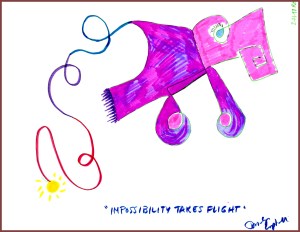
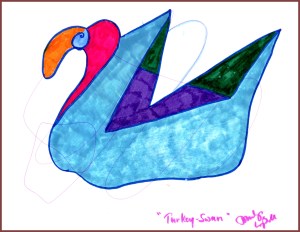
These are examples of two of my creative doodles, the first with my right hand and the second with my left hand.

Right hand: Impossibility Takes Flight

Right hand: Impossibility Takes Flight

Left hand: Turkey-Swan

Left hand: Turkey-Swan

I include them to demonstrate that NO artistic talent whatsoever is required for this activity.

I love color and I enjoy coloring, so sometimes I do this just for fun. But it’s an activity that can also provide a little personal insight if you take the extra step and either journal about the pictures or at least tell yourself their stories. Another thing to do is write down the first five or six words that come to mind when you look at a finished drawing.

This doodle, Bird’s Eye View, is one of my favorites.

Right Hand: Bird's Eye View

My doodles tend to include a lot of critters, among them a one-eyed flying fish and a rather demented frog. That’s just what I see. So now you know.

CDZA: collective cadenza of crazy good music

CDZA is composed of many musicians, some from Julliard School of Music and other music schools such as Manhattan School of Music, Berklee College of Music, and Brooklyn College of Music, along with several Broadway singers. For the past nine months they have been working on a project to create “musical video experiments.” These are some of my favorite results. But there are many more, so check out their website.

What a Wonderful World as you’ve not heard it before:

It’s too late to order fries:

Great singer–and I love the guy in the Elton John glasses:

A little sad; a lot funny:

eve dreams (novel excerpt)

An excerpt from my novel-in-progress, Skin of Glass.

Red sunset

Red sunset (Photo credit: Wikipedia)

Eve dreams she’s naked and nailed to a wooden cross on the side of a hill. The rest of the hillside is planted and staked with symmetrical rows of grapevines. The sun is setting straight ahead of her and the cloud-filled sky is a tumultuous gothic wash of purples, golds, mauves, and deep blues. It reminds her of the sky on the holy pictures she collected when she was eight or nine years old and stuck between the pages of the prayer book her grandmother in Illinois sent her. To the right and down the hill there’s a small clearing with wooden tables and benches where a group of people is having a party or a picnic. She recognizes the voices: her mother, her father, Nana and Jack, and her cousins, aunts, and uncle. Ethan and Jesse are there, too. They’re talking and laughing among themselves, paying no attention to her. As the sky darkens, they light some small candles.

Eve isn’t cold and she doesn’t feel any pain, but she can’t bear being so exposed and powerless.

When the sun finally sets, there’s no moon. The only light comes from the candles, which begin to flicker wildly as a warm wind moves toward the table. The wind snuffs out first the candles, then the voices. When Eve can no longer see or hear anyone, calmness settles over her. She slips free of the nails and glides, like a bird on a current of air, away from the hillside, away from everyone, into the darkness and something unknown.

Eve wakes up suffused with the memory of flying and of freedom. But she’s stuck fast, pinned like a butterfly to the bed, where Ethan’s right leg and arm hold her down. She thinks the phone might have rung, looks at the clock, tries to adjust her legs. It’s only eight thirty. And it’s Saturday. She closes her eyes and sinks back into sleep.

The ringing phone wakes her again and Ethan stirs, allowing her to move his arm and leg so she can get out of bed. She grabs a T-shirt, pulls it over her head, and hurries down the hall, brushing hair out of her eyes.

“Hi, honey.” Her father’s voice is low. “Did I wake you?”

“It’s OK, Dad; I should be up anyway.”

“I just wanted to confirm I’m picking you up at six-thirty tonight.”

Eve is instantly wary. That’s the time he always picks her up for dinner.

“Were you out last night? I called but your machine picked up.”

She can tell he’s making an effort to keep it casual, but her muscles still tense and she grips the phone tighter. “Dad! Are you checking up on me?” Of course, if she weren’t keeping things from him she wouldn’t have this problem. She makes an effort to soften her tone. “Hey, where are we going tonight, anyway?”

Silence.

“Dad?”

“Your choice, honey. I’ll see you at six-thirty.”

She hangs up. The weight of his concern feels like a force of gravity, anchoring her to the ground, making her clumsy and slow.

She stops briefly in the bathroom, opens the medicine cabinet, and looks at the bottle of Valium. Then she closes the cabinet door, pads back to the bedroom, and climbs into bed beside Ethan. Now awake, he nuzzles her chin with his beard, kisses the hollow of her neck.

“Who was it?”

“My father.”

“What did he want?”

“He wanted to talk to me. If the two of you are so interested in each other, why don’t you just get together and stop using me as a go-between?” She regrets taking out her frustration on Ethan as soon as the words leave her mouth.

“You know I’m not interested in your father,” Ethan says, evenly. “I only ask out of self defense.”

She sighs. The tightness at the base of her skull means the start of a headache. Ethan lifts her T-shirt away from her breasts and lightly licks a nipple until it hardens. He’s in the process of pulling the T-shirt over her head when the phone rings again. With another sigh, Eve takes hold of her shirt and pulls it back down. As she starts to get out of bed, Ethan reaches an arm around her waist to keep her there. “Let it ring. Daddy Dearest can wait.”

She pushes his arm away, gets up, and walks back down the hall. She returns a few seconds later. “It’s for you.”She pulls her terrycloth robe from the hook on the back of the door and heads to the bathroom.

In the shower, Eve lets the hot water beat against her neck and shoulders, as she examines a nickel-sized dark purple bruise on her hip that flares dramatically against her milky white skin, trying to remember how she got it. A smaller bruise on her right elbow, where she smacked it against the doorframe, is already fading. She’s been so uncoordinated lately. She tests the outside of her thigh for soreness, then takes a long time washing every part of her body.

When she shuts off the water and pushes back the shower curtain, she finds Ethan braced against the sink, staring at her. He’s wearing the dark blue bathrobe she gave him for Christmas, which he keeps in her apartment. He’s holding a mug of steaming coffee that he hands it to her without comment. She turns her body sideways as she steps out of the shower, hoping he hasn’t noticed her latest bruise. She accepts the mug and takes a couple of sips before handing it back and drying herself off with a large white towel.

As he watches, she wraps another towel around her wet hair and puts her bathrobe on.

“Do you want to know why she called?”

“I don’t even want to know that she exists, Ethan! Why would I want to know why she called?”

“Eve…”

“She’s the mother of your child. She has 24-hour access to you. She has my fucking telephone number!” As if from a distance, Eve listens to herself losing control. She yanks the towel away from her head and throws it on the floor. She grabs her brush and furiously tugs at her tangled wet hair. The day has already slipped away from her, spinning off into a gloomy darkness, yet she’s powerless to dial down the stridency in her voice. She can’t ask Ethan to stay, even though that’s what she wants to do. Her face sets in a hard, closed expression.

Ethan goes into the bedroom, where Eve hears him getting dressed. She’s still brushing her hair when he reappears in the doorway. “I have to go.”

“Of course you do.” This is the one Saturday of the month Ethan doesn’t have Molly. Correction: the one Saturday he wasn’t supposed to have her.

“I’ll call you this afternoon. Do you want me to pick something up later for dinner?”

She shakes her head. “I’m having dinner with my father.”

“Ah.” He nods.

She looks at his reflection in the mirror and feels the air between them thicken, the space between them expand. She wants to touch him, to say something, but she’s stuck to this spot and he feels too far away, already gone.

She hears his footsteps on the bare wooden floor, the thud of the front door closing. She puts her hairbrush down, opens the medicine cabinet, and takes out the bottle of Valium. She washes down two pills with the cooling coffee from the mug Ethan left on the counter. As she swallows the rest of the coffee, she closes her eyes, leans against the edge of the sink, and tries to remember what she dreamed about this morning—something good, wasn’t it? Something about flying.

you can’t have too many keywords

This is a post from my other blog, Nine Paths (exploring the highways and byways of the Enneagram), It’s pretty popular over there, and since I wrote about journaling here last time, I decided to rerun it. I’m currently working (journaling) with a list of keywords I’ve come up with as a result of some list-making exercises. I have to say that keyword journaling has probably been the most profound journaling I’ve ever done.

~ ~ ~

KEYWORDS:
THE MADELEINES OF JOURNAL WRITING

Marcel Proust in 1900

Marcel Proust (Photo credit: Wikipedia)

Before starting this post, I went into the closet in my office in search of three plastic sandwich bags full of folded slips of different colored paper with words typed on them. I’ve used those bags (and words) in my own creative writing exercises as well as in writing workshops. I found one bag full of lime green nouns, one bag full of fuchsia verbs, and one bag full of teal adjectives. I opened the teal bag without recalling what kind of words were inside and pulled out newNew is good—and so apt for the beginning of a post!

I’ve been playing around with individual words and phrases for decades. My Stance Keyword Comparison Checklist was an outgrowth of a long-term fascination with arranging and grouping words that seem to evoke a concept or a mood or an attitude or a way of being. Sometimes it’s easier to gauge your reaction to a list of keywords than it is to read through narrative descriptions. A single word can send you off on a journey, much like the madeleine that sent Marcel Proust off in Remembrance of Things Past.

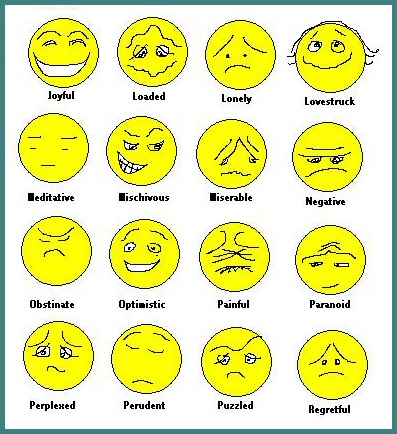
When I was a substance abuse counselor, I used a two-page handout called “How Do You Feel Today?” It consisted of 140 words that described feeling states, each one illustrated by what was essentially an emoticon (although I’m pretty sure the handout pre-dated emoticons). It wasn’t in color, but it looked a little like this example (without the misspelling).

Then I came across a laminated poster based on the same concept, but with far fewer than 140 feeling words and emoticons. It was standard practice at the beginning of group sessions at the clinic for everyone to take turns checking in to let the group know how they were doing and what had transpired since the previous week. I wondered what would happen if we switched to using the feeling words poster in place of the usual check-in. So one day I stuck the poster on a wall and asked everyone to take a long look at it before sitting down so they could find the word that best represented how they were feeling or the state they were in at that moment.

The results were amazing and quite profound. Check-in took a fraction of the time. No one felt compelled to elaborate. And we all agreed we had a much better sense of what was going on with each person than we’d had with the standard check-ins. My take was that having to come up with a single word caused them to really focus and get in touch with how they were doing on a deeper level. It helped them make a transition so they could be fully present at the start of the session. It seemed that previously it had taken the entire check-in period before everyone was “present.” So, by unanimous agreement, we stuck with the feeling words check-in from then on.

Keyword Journaling Exercises

Keywords can be incorporated into a number of different journal writing exercises and techniques. A few suggestions:

  • Use a single keyword or a string of keywords as a prompt for timed flow writing.
  • Mind-map a keyword (as an option, when your mind-map is complete, finish with a period of timed flow writing).
  • Make a grab bag like my plastic sandwich bags by cutting out slips of paper and writing keywords on them. Pull one out at random to use as a writing prompt.
  • Create a sentence or a question around a keyword to use as a writing prompt.

Related:

diaries, journals, and revelations

Diary

Diary (Photo credit: Barnaby)

I filled numerous diaries during elementary and high school, divulging my deepest secrets alongside the mundane details of everyday life. I had one-year diaries and five-year diaries. Some were gilt-edged, while others were plain. But no matter how simple or ornate, they all had locks.

When I was 11 or 12, one of my younger brothers rummaged through my dresser drawers and managed to find, unlock, and read my diary. When I complained to my mother, she told me to put it somewhere he couldn’t find it. I thought this unfair and unreasonable, so I consulted a higher authority: Ann Landers. Ann did not publish my letter, but she did write back agreeing with me and suggesting how I might approach this issue with my mother. I showed the letter to Mom, but she was not moved to alter her position. At least I felt vindicated.

Those old diaries are long gone. I switched to college-ruled spiral-bound notebooks somewhere along the way and started referring to them as journals rather than diaries.

My mother used to read excerpts to me from the five-year diary she’d filled between the ages of 16 and 21, which I think was the only diary she ever kept. The passages she read revealed a rebellious streak it may have been unwise of her to share with me, given her ongoing attempts to get me to conform to various social standards.

After she died, I got custody of her diary and read all of it in the course of a week. I’m so grateful to have it for the glimpses it provides of the young girl and young woman she was before becoming a wife and a mother. She missed writing only two or three days in the entire five years, filling every narrow line with both facts and impressions in her tiny, precise handwriting.

My own journals have been much less devoted to facts than to speculating, imagining, complaining, whining, planning, philosophizing, analyzing, rationalizing, and wishful thinking. Although I wrote in my notebooks regularly for years, it was in a very undisciplined manner. Some entries are so self-indulgent they make me cringe to read them. I’m mortified at the thought anyone else might see them. Twice I’ve ritually destroyed all the journals in my possession (once melodramatically and once thoughtfully). Even so, those journals were my faithful companions, and I derived much benefit from them.

After I encountered Ira Progoff’s book At a Journal Workshop, I began using journal writing in a deeper and more creative manner. I’ve subsequently gotten inspiration and direction from many other books and courses. When I worked as a substance abuse counselor, I realized that the practice of writing might be beneficial for my clients. We experimented with writing first in one group and then in another. Initially, some people were skeptical of the process and diffident about their writing ability, but journal writing doesn’t require talent, only willingness and honesty. Almost everyone responded positively to the writing exercises, and a few began keeping their own private journals. Sometimes the results were absolutely breathtaking, surprising both the writer and me.

When I returned home to California after my mother’s funeral, I wrote to her in my journal every night for several weeks. It helped me say good-by to her, which I had not had the opportunity to do before she died. It made me aware of the connection that will always exist between us. I did the same thing after my partner of nearly 30 years died. Journal writing has helped me get through the most difficult losses of my life.

I’m still writing in college-lined, spiral-bound notebooks. Still using my journals as a way to sort things out, understand myself and my world better, and gain perspective on whatever issues I’m dealing with. I’ve cut down on the whining, complaining, and rationalizing, but I haven’t eliminated them completely. My journals are still my faithful companions—a little reproachful from time to time, but generally nonjudgmental.

how i misspent my youth

This is the second guest post from Rich Jones, who previously shared some ramblings on his place of employment, an antique store (what’s the big deal with Charles Bukowski?). Here he offers a few brief episodes from his aimlessly misspent youth in San Francisco in the late 60s/early 70s—which back then was probably the best city in the world in which to aimlessly misspend one’s youth. They may remind you of the old adage God watches out for drunks and fools.

Looking east down Geary Boulevard from 36th Av...

Looking east down Geary Boulevard from 36th Avenue. (Photo credit: Wikipedia)

will work for weed

When I was thirteen, I got my first job delivering the morning paper with a couple of school chums, brothers who dealt marijuana on the side and paid me a lid per month instead of cash to help them with the route. I’d get up at 3:00am and bike to the corner where the distributor dumped the papers; then the three of us would sit around inserting adverts and folding and loading the papers into a canvas shoulder bag while smoking dope. We’d hit the pavement by around 4:00am.

We delivered papers in one of the tonier neighborhoods in San Franciso—Presidio Heights—which includes a gated cul-de-sac, Presidio Terrace, on Arguello Boulevard. Among others, it was home to then Mayor Joseph Alioto and then Supervisor, now Senator, Diane Feinstein. We had to go door-to-door once a month to collect the subscription fees. Oddly enough, the greatest concentration of deadbeat accounts, those who “paid by mail,” but in fact didn’t pay at all, was within the Terrace.

Eventually, the brothers got tired of the paper route, so I took it over as a sort of sub-contractor, still working for marijuana. I really enjoyed that job; I liked the deserted streets, the cool morning air, the walking around, and of course, the dope smoking. Unfortunately, I lost it after about a year when the paper consolidated routes and began requiring car ownership for delivery people. But it was fun while it lasted.

boots in the sand (stoner version)

When I was still in junior high, I cut school a lot to hang out with an older group of stoners. They liked to hang out in Lincoln Park, near the southwest corner of China Beach, a place called Eagle Point. It was near a contemporary style wood-sided house occupied at the time by members of a local rock group known as “The Jefferson Airplane.”

One evening, some of my friends and I were out there drinking beer and smoking pot, when I felt the call of nature, got up, and staggered downhill. Coming around a bush, I suddenly found myself treading air and plummeting down the cliff face, too drunk to be scared until I was well on my way. I was wearing a three-quarter-length leather jacket I’d scored at a thrift store only weeks before, which kept me from shredding my back against the rocky shale as I slid down.

As luck would have it, the tide was coming in, and I landed up to my knees in partially liquefied beach sand. The sand was like glue, and the only way I could move was to step out of the pair of knee-high suede cowboy boots I’d spent several months of odd job wages on (earned in the underground economy of the time) at a surplus store on Market Street. Totally shaken and scared witless, I half crawled, half waded through frigid, knee-deep water to China Beach, weighed down by my wet clothes and the leather jacket. From there, I managed to walk from 28th Avenue to 10th Avenue and Anza Street in wet woolen boot socks, raising a set of blisters the size of Kennedy half-dollars on the soles of my feet. Thanks to the cold sea water, adrenaline pumped into me during the fall, and the long walk home, I was stone cold sober when I got to the front door; thus, I managed to sneak to my room, avoiding embarrassing parental inquiries.

When I saw my friends at school the next day, they all swore they’d been completely unaware that I was missing.

fade to blue

While nominally attending high school, my wiseacre friends and I spent much of our time hanging out in an area known as “the Pit,” which was located under the western side of the concrete stands of the football stadium. The Pit had restrooms that were kept locked except for game days and a windowless utility/storage room where the groundskeeper, whom we all called “Jack T. Gardener,” kept his equipment. Jack was pretty cool. He would unlock the restroom when we had a quorum and didn’t report us when we smoked cigarettes or drank beer there. He even kept some softball equipment for the impromptu games we held in the early afternoons when we were buzzed and mellow. In exchange, we kept the Pit cleaned up and carried our empties off campus so he wouldn’t get into trouble when the boys’ dean, who shared a last name with Sherlock Holmes’ nemesis, came snooping around.

My best friend, Ed Chung, was part of this group. One day while the two of us were wandering stoned and happy down Clement Street, we found a box of plastic sunglasses in the trash outside the now long gone Owl Drugstore. Their frames were of various styles but all of the same rather unattractive shade of blue (probably why they were being thrown out). We took them over to the Old Man Shack where seniors played checkers and smoked themselves to their graves in Mountain Lake Park and sorted them out. In the process, I discovered I could wear two pairs at once, with the second pair resting atop the first so I looked like I had four eyes. Ed tried on two pair as well, and we both laughed till our sides ached. Then Ed thought up a stunt we could pull, which he organized and we carried out that very evening.

Around 8:00pm, Ed, his older brother, Ray, our friend Chris, and I all met at a tennis court off 25th Avenue and smoked a joint. We then walked out to four bus stops westbound along the 1 California Electric Line and spaced ourselves one stop apart, between 25th and 32nd Avenues, where the line turns south at Lincoln Park to loop back towards downtown. Each of us was wearing two pairs of blue framed sunglasses, one pair atop the other. The bus, with only a few passengers, stopped for each of us. We got on, paid our fares, and seated ourselves from front to rear. When the bus arrived at the 33rd Avenue turn-around, we all got off. The driver didn’t say a word, but he definitely gave us the fish eye.

We managed to get through this stunt without cracking up on the bus. Afterward, we headed to Eagle Point to smoke more dope.

ice sledding in San Francisco

There used to be an ice vending machine at a Union 76 service station located on Geary Boulevard at Stanyan Street. For, as I recall, a dollar you could get either large bags of crushed ice or solid 12×12 ice blocks.

The doors through which the ice was dispensed were large enough for a slender teenager to crawl through. So we’d climb in and steal blocks of ice and then haul them the six blocks over to the Presidio Golf Course via Arguello. Along the way, we’d scrounge copies of the throw-away newspaper The San Francisco Progress which typically accumulated unread on front porches and in the vestibules of flats and apartment buildings.

The Presidio Golf Course had a hill to the west, just past the clubhouse near the Arguello Street Gate, that sloped steeply and dramatically down towards Mountain Lake Park. We’d take the ice blocks up to the crest of the green, put the pilfered newspapers on top of them, and then ride them down the manicured hill—typically stoned out of our minds.

When pursued by the MPs, which was frequently, we’d escape by crossing a deep, concrete culvert that ran parallel to the hill and was choked with blackberry bushes. After crawling under a chain-link fence and scarpering for the nearby park exit at 6th Avenue, we escaped onto Lake Street, scratched and bleeding, but free. We never once got caught.

Cloud Atlas (the movie/my opinion)

Cloud Atlas

To do any kind of a comprehensive review of Cloud Atlas, I would have to have seen it more than once, which I haven’t. At least not yet. Other people all over the internet have tried their hands at interpreting and explaining it, dissecting it into bite-sized pieces to tease out all the hidden and not-so-hidden layers of meaning. The reviews range from the positively rhapsodic to the totally dismissive. As for me, I enjoyed the movie well enough that if I don’t get another chance to see it on the big screen, I’ll probably get the DVD. The extras are sure to be worth it.

Much of the detail of the book was still fresh in my mind when I saw the movie, so I was a bit preoccupied with comparing one to the other—and comparing my mental pictures with the directors’ pictures. Someone seeing the movie without having read the book would be spared those distractions. But they would not be spared the distraction of trying to figure out who was who (actor-wise), since each of the major players had roles in several different stories/time periods, sometimes made up and costumed to a fare-thee-well. I understand the intention behind this choice of casting, but it did interfere with my suspension of disbelief. I think I would find a second viewing more satisfying because it would be easier to focus on the storylines.

And the storylines are very good. All six stories are compelling, even more so in the movie. Part of the reason may be that so much material from the book had to be cut in order to make this three-hour movie. Editing is a boon to any kind of writing. Raymond Carver didn’t begin to gain notoriety until editor Gordon Lish slashed a collection of his stories to the bone. It’s an imperfect analogy, though, since the filmmakers did create a couple of scenes to either dramatize an element or to outright change an outcome .

I also thought interspersing the stories—which wasn’t really an option in the linear narrative of the book—worked much better to illustrate the themes of interconnectedness, oppression, and reincarnation. There was an awful lot going on, but it wasn’t difficult to keep track of.

As spectacle, the movie is a winner. The sets, costumes, writing, acting, and directing are all first rate. As mini-morality plays, each individual story is a winner, too. But the stories don’t add up to more than the sum of their parts, which the book and movie are both trying to convince us they do. Is it necessary that they do? I don’t think so.

The Wachowskis have directed a couple of movies I really enjoyed, 1996’s Bound and 1999’s The Matrix. But I haven’t quite forgiven them for V for Vendetta, which I thought was absurdly heavy handed and completely lacking in subtlety. Of course, it was adapted from a graphic novel, which was probably the right format for it. Cloud Atlas redeemed them, in my opinion. I hope the movie gains a following because it deserves to be appreciated for what it is, not for what it could be, should be, or has delusions of being.

Cloud Atlas (the book/my rant)

Cover of "Cloud Atlas"

Cover of Cloud Atlas

The talk I’d been hearing about Cloud Atlas from the time of its publication in 2004 was that it was both brilliant and a difficult read. So although I purchased the book in January, I left it parked on my bedside table for several months. I wasn’t tempted to begin reading it until I learned the Wachowskis (formerly the Wachowski brothers) had made a movie of it. Both a story in The New Yorker about the making of the movie and a long trailer for it on YouTube heightened the intrigue. Thus I finally undertook to read the 509 page tome. Since I was under the assumption the book would be hard to get into, I was pleasantly surprised to find that wasn’t the case at all.

I should state up front that I tend to read at face value—especially the first time around—rather than with the intention of fitting all the pieces of a puzzle together. So if I’m reading a mystery and can figure out whodunit before the author reveals it, I consider the story to have been poorly plotted. In the case of Cloud Atlas, I noted the links between the characters living in different time periods and tolerated the abrupt passages from one section to another, even when they came mid-sentence. But I wasn’t trying to work out the meaning of it all.

This was my first introduction to David Mitchell, and I initially felt that he did an outstanding job writing in multiple genres and holding my interest with each new storyline. At least that was my impression when I posted my movie review of The Words, wherein I made a brief, favorable reference to Cloud Atlas. That was before I reached page 239, which begins the section titled “Sloosha’s Crossin’ an’ Ev’rythin’ After”—an entire 70 pages written in dialect!

I’ve taken a number of writing classes and workshops and have read dozens of books on fiction writing. It’s pretty well ingrained in my brain that the guidelines for using dialect in a novel can be summed up thusly: don’t do it! The reason to avoid dialect is quite simple. Dialect makes it hard on your readers. It slows them down. It takes them out of the story.

As a writer, why would you want to do that? Don’t you want your readers to maintain their suspension of disbelief? Don’t you want them to be so engrossed they can’t put the book down, even if it is 509 pages long? If you’re David Mitchell writing Cloud Atlas, you’re already a little on the ropes with your readers with your Russian doll story architecture. So why would you also force them to slog through 70 unrelenting pages of dialect smack in the middle of the book?

Had I not been committed to seeing the movie to find out how the directors dealt with the multiple time periods, I would have given up on the book after the first 10 pages of “Sloosha’s Crossin.’” As it was, I kept thumbing through the section to find out how many more pages there were. I even skipped paragraphs and whole pages here and there, mumbling dark thoughts about the author’s self-indulgence. Just because you can do something doesn’t mean you should do it.

I finished the book, but my annoyance over those 70 pages turned me off to the point where I could no longer suspend disbelief enough to get back into the other stories. When I got to the end, I did not have any epiphanies—and probably wouldn’t have under the best of circumstances, given the conclusion—I just slapped the book closed, relieved that I had made it through.

My next thought was that I really need to reread One Hundred Years of Solitude.

By the time I went to see Cloud Atlas, the movie, it was with the same trepidation with which I’d begun reading the novel. However, that experience was much more satisfying. Tune in next time for my totally rant-free take on the movie.

paradise?

This is another gorgeous animation short, mixed media this time, by Ishu Patel, titled “Paradise.” The music is by Zamfir.

When I saw it, it reminded me of the creation story I wrote over a dozen years ago for a mythology class, very loosely based on Buddhism and quantum physics’ theory of the unified field.

the yearning of desire

In the beginning, All was One, and the One was nameless and without form. Within the One existed All Things. But there were no distinctions within the One; no thing was separate from any other thing. Although countless aeons passed, there was no experience within the One of the passage of time. Gradually, from within the center of the One, arose the beginning of Desire. At first Desire was like a small bubble rising to the surface of a perfectly still lake. At first Desire was only the softest whisper of the wind. Desire wanted to give form to the formless and to name the nameless. Desire yearned for forms to touch and to surrender to.

More aeons passed, and Desire continued to grow within the One. Desire pulsed within the center of the One, louder and stronger, and the pulsing of Desire gave form to Spirit, that which inhabits all and everything. Spirit allowed himself to be inspired by Desire and to contemplate all the possibilities that form could take. Spirit saw that formlessness needed form, just as form needs formlessness. Spirit saw that formlessness needed form to complete itself. Spirit then dreamed the dream of the universe taking form, from its beginning to its end, which was not really an end but only a return to formlessness. As Spirit dreamed the dream of creation, Desire allowed herself to be infused with Spirit, and as she did, she took the shape of a large, graceful bird, covered in the palest of green iridescent feathers. Spirit was the air that she breathed.

Spirit longed for the forms that he had dreamed of. And Spirit longed to be inhaled by Desire, just as Desire longed to breathe Spirit. With each inhalation of Spirit, Desire flapped her pale wings. As the flapping of her wings increased, the colors of her feathers deepened into verdigris and copper, turquoise and silver, aqua and gold. She spread her wings and flew in a wide, lazy arc, and she sang the purest, most exquisite songs, whose haunting echoes trailed behind her. She coasted on the currents of air that were Spirit.

As Desire breathed in more of Spirit, she too began to visualize the forms that Spirit had dreamed of. As her yearning increased, so did the flapping of her wings. Her tail feathers grew longer and their color changed from pale green to deep red. She swooped and glided through Spirit, inhaling more and more of his visions. The feathers of her body turned crimson and saffron. Desire felt something growing inside her, in the same place where her yearning had first begun its delicate pulsing so many aeons ago. She flapped her wings again and soared upward. An indigo band formed around her neck. Her singing became louder, more rhythmic, and more intense. It filled the entire universe with its insistent, rapturous vibrations. Spirit was enthralled by the songs of Desire and continued to fill her with the countless forms he had dreamed of.

Desire was full of a longing so powerful that she thought it could never be filled. The feathers of her head changed to amethyst and violet, and a royal purple crest took shape along the top and back. She opened her mouth to cry out but no sounds of any kind emerged, neither cry nor song. Instead, when she opened her mouth the countless forms of the universe began to spill out into the air, into Spirit. Each time she opened her mouth more forms issued forth until everything that Spirit dreamed had been given its form. Spirit was satisfied because he was everywhere, inhabiting all of the forms of the universe. But Desire, without whom no form could exist, could not touch them, could not fully satisfy her yearning. It is the nature of Desire to remain unfulfilled. And we, too, who were given birth through Desire, know that no matter what we have, something is always missing. Though Spirit fills us and gives us joy, there is a place in our hearts that it cannot touch. Desire is the permanent longing in our hearts for home, for the One, for formlessness.

Post Navigation