give me a daisy

~ ~ ~ ~ read ~ write ~ look ~ listen ~ create

San Francisco poems (1974)

last days

English: Fog at Ocean Beach in San Francisco i...

Fog at Ocean Beach in San Francisco is clearing up (Photo credit: Wikipedia)

Smoke dreams,
the days went in a haze
of musky air;
green and gold and lavender
love-spangled hours,
sun-dappled minutes;
fleeting glimpse
of someone
here or there.
Yellow.
Red.
In dreams conceived and born,
short-lived,
to dust return:
finely colored ash,
dissolved and lost.

ocean beach 

I.
Splash!
and a riot of foam:
the waves
roll in,
swallowing
the beach meticulously,
inch by inch,
sucking in
pebbles and shells
and footsteps
of bathers—
unwrinkling the shoreline
and retreating.

II.
A small bird
tracks
delicately
across
the newly varnished
surface
of the sand.

55.

lady,
inking a path
thru the night;
new words,
old words—
desires
translated into safety.

sleep
with a dream
or a pen
always breaks
in the coming of the dawn,
whose grey reality will
tear the page and
rip the fabric
of the night.

the infinity of possibilities
ends here
in the clarity of morning:
I don’t touch you,
not even with my words;
and the dreams are only
dances
on the far edge
of the lush and tender forests
we could know.

56.

Sometimes a goldfish,
I swim thru
the city’s nightwater
lit brightly from the top.
Neon and stars
indiscriminately
weld their light together:
a gold fishnet
of infinite capacity.

In the damp Pacific air
all the city is an ocean,
full of frogs,
and fish like me,
and seaweed
that tangles in my hair
and ties me
to the concrete ocean floor.

music made visible

Violin_CymaGlyphA3_280108_pdfPlease check out the website for Cymascope (music made visible), where you can see music notes as “holographic bubbles.”

musicmadevisible is a new concept in musical expression, a stream of cymatic images representing an analog of music in visual form. If our eyes could see music we would not see waves, as is commonly believed, but beautiful holographic bubbles, with shimmering kaleidoscopic patterns on their surface. The CymaScope allows us to see this previously hidden realm of beauty.

There is much more information about how this works on the website, which also has a CymaPiano. You can click on the keys to see what each note looks like. Plus there’s a “cymatics experiment,” a short video of Pink Floyd’s Welcome to the Machine. So cool!

Chinese restaurant (novel excerpt)

This is another excerpt from my novel in progress, Skin of Glass.

Five-Happiness-Restaurant-San-Francisco-Interior

Five-Happiness-Restaurant-San-Francisco (Photo credit: foodnut.com)

November 1990. At the end of his shift at the bookstore, Ethan intends to grab a sandwich from the deli and go home to work on his paper on symbolism and surrealism in Modern Greek Literature. But once he’s behind the wheel of his car, he’s thinking not about Greek Literature but about Eve. Again. His plan falls apart at the first red light; fifteen minutes later he’s in a phone booth on Van Ness Avenue dialing her number. It’s rush hour and the blare of traffic and stink of exhaust fumes make him dizzy. His nerves are frayed and his reflexes dulled from lack of sleep. If he doesn’t finish his paper by the end of the week, he’s going to nail an incomplete. It goes without saying he isn’t getting any writing done.

When he started daydreaming about Eve, it was a harmless fantasy. Then he began seeing her face everywhere. It’s reached the point where he has to talk to her, at least hear her voice, hear her say his name, if only to tell him to go to hell. He feels as though he’s waiting for the results of some medical tests that mean everything: life or death.

She answers the phone distractedly, but after he identifies himself, she says, “Ethan!” clearly surprised to hear from him. Possibly pleased? Or is he projecting? When he says nothing else, she asks him if anything’s wrong.

“No, nothing’s wrong. I just wondered…have you eaten yet? Do you want to get something to eat?” There’s no warmth in his voice, no invitation. His hand is clamped around the receiver, and he’s staring through the grimy glass enclosure at the three lanes of cars stopped at the corner for the light.

“With you, you mean?”

The light turns green. The booming bass from a passing car vibrates along the pavement and travels up Ethan’s body, all the way to the hand holding the receiver. He says, “Yes,” amid the sudden crescendo of gunned engines. He feels his mouth form the word, but he can’t hear his own voice. When she doesn’t respond immediately, he wonders if he actually said it out loud, if she heard him. He won’t say it again.

“Sure,” she says. “But I need to change; I just got home. Can I meet you somewhere?”

He hadn’t thought that far, but the image of her sitting across from him at that Chinese restaurant pops into his head. He doesn’t remember the name, but she does, and they agree to meet there in an hour. When he hangs up, he looks through the phone book for the address, then walks swiftly toward his car, which is parked illegally across the street. The darkness seems to have deepened in the space of his telephone call, or in response to it. He could go to the library and get a little research done. At least he’d be doing something productive. But until he sees her and settles this thing somehow, it’s hopeless to try to carry on with his everyday life.

The restaurant is on Grant Avenue in Chinatown, an area he doesn’t know. He drives across town and spends twenty minutes trying to find parking. Even this time of year, the street is noisy and crowded, bustling with automobile and foot traffic. He parks on a side street a few blocks from the restaurant and tries to walk off some of his nervous energy. It’s cold and windy; he moves with his head down, his hands stuffed into the pockets of a gray down vest, not looking at anyone, and not bothering to glance into any of the lighted store windows filled with cheap souvenirs and garish clothing. What exactly is he doing? It would have been better for everyone, including him, if Eve hadn’t been home, or if she’d refused to meet him. In fact, he thinks she should have refused. He’s already mentally convicting them of betraying Jesse, although the only betrayal so far is his, and it doesn’t have to go any further.

He enters the restaurant, immediately fortified a little by the aroma of garlic and ginger. The petite smiling hostess shows him to a table for two, assuring him she’ll watch for Eve. He orders a beer, shrugs out of the down vest, and leans back in his chair. He looks around, trying to remember where they sat when they were here for the birthday party. Several tables had been placed end-to-end. But it was a long time ago, and all he can picture is Eve and the heavy red draperies and table linen.

He glimpses himself in the mirrored panel of a room divider and almost doesn’t recognize himself. He looks like a vagrant, somewhat sinister. He goes to the restroom to splash his face with water, run his fingers through his unruly mass of hair, and wash his hands. The whites of his eyes are so bloodshot they look pink; there are dark circles under them. A clear, firm voice in his head says, Leave now. Just go. But he can’t.

He’s back in his seat taking a sip of beer when the hostess leads Eve to the table, both of them smiling as though they share a happy secret. Ethan rises but doesn’t touch her, doesn’t smile, just says her name, “Eve.” Once they’re seated, a waiter places a pot of tea on the table and hands them menus. Eve slips her arms out of her camel’s hair coat and lets it fall against the back of her chair. What now?

She takes in the room. “I haven’t been here since January.” The memory seems a pleasant one. “Have you?”

“Me?” He shakes his head. “I almost never eat out. That was a special occasion.” He has one hand around the cold, wet glass of beer. He can barely look at her. All he registers is that she’s wearing a pale yellow sweater with a high neckline, and her hair is shorter than he remembers. They focus on their menus, although he isn’t really reading his. “You’re more experienced with this. Why don’t you choose?”

“But what do you like?”

“Anything. I’m not fussy.” Afraid he’s being rude, he adds, “I’m sure whatever you select will be perfect.”

Her skin is almost white. Porcelain. He feels vulgar and coarse by comparison. Classic beauty and the beast; they shouldn’t even be occupying the same table. She studies the menu pages, humming to herself so softly and unselfconsciously it melts him, the same way Molly melts him when she sits on the floor singing made-up songs to her dolls.

Eve recites her choices aloud, then repeats them to their waiter, adding, “not too hot, please.” The waiter—Chinese, with close-cropped hair and wire-rimmed glasses—bows and nods.

“Jesse always gets the Kung Pao Tofu here. This is his favorite restaurant in the City.”

Ethan sighs. Why hadn’t that occurred to him? This is such an amazingly bad idea. Jesse is going to be here at the table all evening. Well, it’s what he deserves.

“Did I say something wrong?”

He shakes his head, suddenly drained, too tired to be here, to be doing this. “No, no. This is probably a bad idea. I’m pretty tired. Not very good company. I’m sorry.”

“You just need some food.” She pours tea for both of them. “Are you taking any classes this semester?”

He laughs. “One. Modern Greek Literature. Which I’m doing my absolute best to fail.”

They pass the time talking about teachers, classes, and homework. When their food arrives, he picks up his fork, but Eve insists he learn how to use the chopsticks. It takes him a few minutes to grasp the concept, and even then he’s far from adept. They slip from his fingers, clattering against the plate, and he drops bits of food on their way to his mouth. The rice is especially tricky. They both laugh at his attempts, but she encourages him and his technique improves.

He asks her when she started doing art and learns her father’s an architect.

“I used to go to his office with him, and sometimes I’d draw these fantastic, elaborate houses while he was working. I wanted to do what he did. In fact I would have gone into architecture, but I couldn’t hack all the math. It would have been a much better career choice than fine art, that’s for sure. But I’m rethinking that.”

“Rethinking what?”

“What I want to be when I grow up. It’s one thing to make art for yourself, but I’m not sure about trying to earn a living with it. And I can’t really say I’m driven by any grande artistic vision. I was planning to be an illustrator, now that I’ve finally mastered the human form.”

“What do you mean?”

“Learning how to draw people was hard. I was always pretty good at drawing things—structures, nature. Inanimate objects, I guess you could say.”

“It’s funny how that works. I still have trouble writing descriptions. If I don’t pay attention my stories all end up taking place in fields of white space. I guess I’m not very visual. I mean I see things but—”

“The trick is learning how to feel with your eyes.”

“Feel with your eyes?”

“I read about it in a book my father gave me.”

“An art book?”

“No. A novel. My Name is Asher Lev.”

“Oh. Chaim Potok. I read that one. Long time ago. So you know how to do that? Feel things with your eyes?”

She blushes. “Sort of. When I first tried it I focused very, very intently, but the harder I tried the more frustrating it was. I couldn’t get it. In high school I discovered the secret. Pot.”

They burst into laughter.

“Is your father an artist, too?”

“Technically, no, but he could be. He used to do these exquisite architectural renderings. When you’d see one you’d just want to live in it. In that world, I mean. But he doesn’t have time for it anymore. I’m not as good as he is.” She shrugs. “But this semester I have a photography course and I love it. Maybe because it’s new. But I can imagine being a photographer a lot easier than I can imagine being an artist. And I mean to get off the dole as soon as I can.”

“The dole?”

“Being supported by my father. He does some work for free, for community groups and nonprofit organizations, and I feel like such a leech that he’s still supporting me. I’d like to be on the other end, you know? Be making some kind of a contribution the way he does. Besides, I’m sure he has better things to do with his hard-earned money.”

“Well, speaking as a Dad,” Ethan says, with mock gravity, “I can’t imagine there’s anything I’d rather do with my money than spend it on my daughter. If I had any money, that is.”

“You say that now, when Molly’s, what? Three? Wait till you’re closing in on twenty years of financial support.”

“So would you stop doing art if you became a photographer?”

“No. I like to play with colors, textures, get the feeling of something or someone down on paper, to preserve it. Everything’s so temporary. This way I can preserve the memories.”

“Hm. Like impressionist photographs.”

“Hey, I hadn’t thought of that!”

By the time they’re finishing the lukewarm tea, he feels as though he’s been on a brief vacation. “This was delicious, every bit of it—at least every bit I managed to get into my mouth.”

“All you need is practice. But you did great for the first time.”

Her lipstick is gone, her blue eyes shining; she looks happy and relaxed, hunched over her teacup tucking strands of red hair behind her left ear. He feels a wave of affection for her. Affection. Nothing more. And he won’t ask for more; he won’t betray Jesse.

The waiter brings the check on a small black plastic tray. There’s a single fortune cookie on it. Ethan barely notices the waiter slip a cookie into each of Eve’s hands, he does it so quickly and smoothly. She blushes again, very becoming, and her eyes widen. She glances at Ethan and then at the departing waiter.

Ethan grins at her embarrassment. “There must be some super special fortunes in those cookies.” He reaches for the one on the tray, opens it with a single snap, pulls out the narrow piece of paper, and reads it aloud. “The road to knowledge begins with the turn of a page.” He rolls his eyes and crunches the pieces of cookie in his mouth. “Preaching to the converted here.”

She opens first one cookie, then the other, reading her fortunes to herself. Ethan waits for her to read them aloud, but she gives him a crooked half-smile and pockets them. He teases her about it, but she won’t tell him what they say. He pulls his wallet out and lays some bills on the tray. She slips her arms into her coat and he shrugs into his vest. On the way out, they nod to the waiter, who bows again and thanks them.

“Where’s your car? I’ll walk you to it.”

“It’s only a block away,” she says. “You don’t have to do that.”

“But I want to.” He presses the palm of his hand against her back, steering her in the direction she indicated. They walk slowly, in a comfortable silence. When they get to her car, she rummages through her handbag for her keys, and a small brush falls to the pavement.

“I’ve got it.” Ethan retrieves the brush and hands it to her. She reaches for it carefully, not touching his outstretched palm.

Suddenly she looks away. “Do you ever feel like you’re living someone else’s life? Like no matter how good you are you’ll never measure up?”

There’s a lump in his throat; all he can do is nod.

“Oh, listen to me,” she says, her tone shifting. “As if I have anything to complain about.”

But of course he knows what she means. He knows exactly what she means.

“Thank you, Ethan. That was wonderful. Such a nice surprise on a cold, gloomy day.”

He wants to say something light in response, but they’re standing too close, and instead of saying anything, he grasps her shoulders, pulls her toward him, and kisses her hard on the lips—waiting for her to push him away, maybe even hit him. But she sways unsteadily toward him so he folds his arms around her and she relaxes against him. A sigh escapes from one or both of them, and they stay like that, standing on the dark street in the cold, next to her car.

in a stranger ocean than I wished

Parachutes, My Love, Could Carry Us Higher

A poem by Barbara Guest

OLYMPUS DIGITAL CAMERA

This is one of my favorite poems. Barbara Guest (1920-2006) was a poet of the New York school, which also included John Ashbery, another poet whose work I admire.

Roll the Dice

Speaking of stranger oceans, here’s a great poem–and challenge–by Charles Bukowski:

if you’re going to try, go all the
way.
otherwise, don’t even start.

if you’re going to try, go all the
way.
this could mean losing girlfriends,
wives, relatives, jobs and
maybe your mind.

go all the way.
it could mean not eating for 3 or 4 days.
it could mean freezing on a
park bench.
it could mean jail,
it could mean derision,
mockery,
isolation.
isolation is the gift,
all the others are a test of your
endurance, of
how much you really want to
do it.
and you’ll do it
despite rejection and the worst odds
and it will be better than
anything else
you can imagine.

if you’re going to try,
go all the way.
there is no other feeling like
that.
you will be alone with the gods
and the nights will flame with
fire.

do it, do it, do it.
do it.

all the way
all the way.

you will ride life straight to
perfect laughter, it’s
the only good fight
there is.

you: a work of art in progress

If you thought of your life as a work of art in progress, what existing art form would it most resemble? The idea of living one’s life as a “work in progress” is not new, and I have come across it many times in my travels. More than a few years ago, when I was struck afresh by the rich possibilities of artistic metaphor, I took a look at my own life in this context and also surveyed some friends. My own answer to the question was immediate and obvious, but I was surprised by every single answer I received from my friends.

An ex-insurance industry executive said that his life would be a multi-media performance piece. A writer described her life as a sculpture, while a musician called his life a “junk” sculpture. A computer  programmer was clear that his life was a symphony. Several years later, I posed the question to several different people and got a whole new set of answers, including:

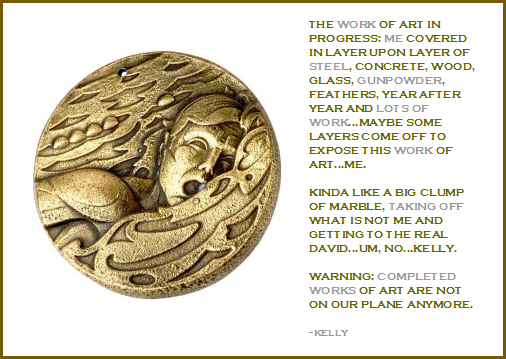
Kelly words

At that time, I saw my own life as a play and this is what I wrote about it:

The things in my life are all stage props; I’m very aware of setting my scenes. All the people in my life are characters in my play and so, of course, am I. I just happen to be writing, directing, and starring in this production which, a friend remarked, would probably be the most expensive play ever produced.

There’s an inherent discipline in living one’s life as a play in progress. This is different from the discipline that’s part of living life as a sculpture or as a painting or as a symphony. In a play, props and scenery are vital–but only to the scenes in which they belong. One can’t become too attached to any particular props. Staging is also important and so are timing and pacing.

I recall being conscious of things as background props and of people (including myself) as characters from an early age. I wrote plays, read plays, directed amateur productions, and hung out with the local drama group. I thought up names and descriptions of characters, along with elaborate decorating schemes, to amuse myself. When I was old enough to notice I decided this was an odd way to think about things. Whereas other people seemed to make choices almost by instinct, I could consider a range of alternatives: the final choice depended on the requirements of the scene or the plot line; choosing otherwise seemed  arbitrary.

That felt like a strange approach, but strange or not, it was my approach. When it came time for me to reinvent myself at a major twist in the plot, I had no difficulty changing my wardrobe, my style, my attitude, and even my name. After all, this isn’t real life–whatever that’s supposed to be.

I wouldn’t use the same metaphor to describe my life now. Some days it feels like a surrealistic jigsaw puzzle: challenging, colorful, so much to look at, still not put together, and not at all what you’d (or I’d) expect.

What about you? If your life were a work of art in progress, what metaphor would you choose to describe it? Would it be a painting, a sculpture, a black and white photograph? A novel, a short story, a play, a poem, an essay? Would it be a symphony, an opera, a collage, a Rodgers and Hart musical, a movie? Or…what?

time, time, time, see what’s become of me

Atomicclock

Atomicclock (Photo credit: Wikipedia)

Lately, I’ve had more things to do than time in which to do them, i.e., I feel as though I don’t have enough time. I know–and you know–that time is not a commodity, much as we often treat it as one. But it’s difficult to stop thinking of it that way. When a friend commented in a blog post that there was no way to create a savings account for time, I immediately perked up. Wouldn’t that be great? I want one of those!

When I met the
Grandfather of
Time, he said
it was no use
struggling.

Even after all
these years he
still had too
much to do.

Running Behind (Brian Andreas)

That doesn’t give me much hope that my relationship with time, and the lack thereof, is likely to change anytime soon.

what is time, anyway? it’s:

  • a nonspatial cotinuum in which events occur in apparently irreversible succession from the past through the present to the future;
  • an interval separating two points on this continuum, measured essentially by selecting a regularly recurring event, such as the sunrise, and counting the number of its occurrences during the interval; duration;
  • a number, as of years, days, or minutes, representing such an interval;
  • a similar number representing a specific point, such as the present, as reckoned from an arbitrary past point on this continuum;
  • a suitable opportune moment or season;
  • an interval marked by similar events, conditions, or phenomena; especially a span of years; era;
  • one’s heyday;
  • a moment or period designated, as by custom, for a given activity; harvest time;
  • an occasion;
  • an appointed or fated moment, especially of death;
  • one of several instances;
  • a prison sentence;
  • the period spent working;
  • the rate of speed of a measured activity;
  • the characteristic beat of musical rhythm.

what does time do? it:

  • passes
  • expires
  • cycles
  • drags
  • hangs heavy
  • flies
  • flows
  • never arrives
  • marks changes
  • stands still
  • places limits
  • ages us
  • saddens us
  • gladdens us
  • gives us hope
  • preoccupies us
  • enslaves us
  • provides us with information
  • is money?

what do we do with time? we:

  • have time
  • have no time
  • save time
  • spend time
  • long for past times
  • want more time
  • look forward to future time
  • waste time
  • savor time
  • hoard time
  • pass time
  • lose time
  • lose track of time
  • fear time
  • serve (“do”) time
  • make time
  • take time
  • keep time
  • keep track of time
  • while away time
  • seize the moment/day
  • manage time
  • take time off
  • use time wisely

but does time even exist?

We have sophisticated machines, like atomic clocks, to measure time. But measuring “time” doesn’t prove its physical existence. Clocks are rhythmic things. We use the rhythms of some events (like the ticking of clocks) to time other events (like the rotation of the earth). This isn’t time, but rather, a comparison of events. We called these manmade devices “clocks.”

But these are just events, not to be confused with time. Indeed, one could measure time by measuring the melting of ice on a hot day. We might even devise a plan to meet for tea at two ice-cube melts or 50 top-spins, which ever “time piece” you each happen to have on hand. Clocks just have springs and things. People get sidestepped into believing time exists as a physical entity because we’ve invented clocks.

From a biocentric point of view, time is the inner process that animates consciousness and experience. The existence of clocks, which ostensibly measure “time,” doesn’t in any way prove time itself exists.

–Robert Lanza, M.D., Psychology Today

Well, whether time exists or not, we experience it; we live as if it is not only real, but often a cruel taskmaster. It might be more effective to try to make friends with time instead of fighting with it all the time.

I’ve already “spent” nearly two ice-cube melts on this post, but before I end, here’s a song about time from a long time ago:

hey jealousy (a short story in dialogue)

hey jealousy

Hey jealousy
She took my heart
Well there’s only one thing I couldn’t start

–Gin Blossoms

Lakeshore Records

Lakeshore Records (Photo credit: Wikipedia)

“Lexie? Is that you?”

“Mark? My God, I thought you were dead.”

“Oh, no. Nothing that serious. Just got a little dizzy after working out in the hotel fitness room. Guess I was dehydrated. I’ll be out in time to catch my plane. But, wow, how amazing to see you here, Lexie.”

“No. I mean I thought you’d died years ago. At the lake. When the Wheelers’ boat sank.”

“What? Well, obviously, the reports of my death have been greatly exaggerated.”

“But—”

“You look fantastic. As beautiful as the picture of you I’ve kept all this time. I’ll bet you’re an amazing nurse. Such gentle hands you had. I remember. I’ve never forgotten those weeks at the lake, the walks we took on the shore, sitting at the edge of the pier and talking so long we got sunburned. Sneaking out behind the back of the boathouse at night. That was a…special time. You were special.”

“But, Mark—”

“Sometimes I wish we could go back, don’t you? Life seemed simpler and sweeter then, without all the obligations, the fuss, the stress. You know what I mean?”

“Mmm.”

“You must have married, Lexie. I see a ring. Any children? Can you believe Veronica and I are celebrating our 30th at the end of the year? Frannie, our oldest, is married, teaching in Kentucky—Kentucky, for crying out loud. But she’s pregnant, so I doubt that will last much longer. God, I’ll be a grandfather soon. And Paul is almost through med school. ‘My son, the doctor.’ What a cliché, huh?”

“Veronica?”

“Of course you remember Veronica. You two were best friends. She’ll be so surprised when I tell her I saw you.”

“Surprised? Yes, I think she’ll be quite surprised.”

“What’s the matter, Lexie?”

“Tell me about Frannie. How old is she? What’s she like?”

“She’s twenty-nine. Pretty and smart. Hell-bent on having a career before settling down to raise kids. Didn’t want to be like her mother, getting married and having babies before she finished college.”

“And how is Veronica these days?”

“Oh, she’s fine. Stays busy with the house and the cabin. And she has her committee work with the arts guild and a couple other groups. Right now she’s in Kentucky helping Frannie get ready for the baby. We’re both excited about our first grandchild.”

“Why didn’t you ever call me, Mark? Or write?”

“I thought you didn’t want me to. You’d met someone else, hadn’t you? It was Veronica, come to think of it, who told me you’d left with him. I was in shock when she told me, Lex, to tell you the truth. I’d thought you cared about me the way I did about you.”

“I left the lake because my mother fell and broke her arm and needed my help at home. You were off hiking with some of the other guys, so I wrote a note and gave it to Veronica to give you. She came to visit me a few weeks later. I trusted her, so I confided in her. She told me about the accident with the Wheelers’ boat.”

“Yes, that was a terrible thing. Mr. Wheeler’s youngest son, Petey, drowned.”

“But you weren’t on the boat.”

“No.”

“And you and Veronica?”

“Rebound kind of thing, I guess. And then she got pregnant, so we got married right away.”

“Well, I have some other patients to attend to. It was good to see you.”

“Lexie?”

“Say ‘Hi’ to Veronica for me. And just so you know, Mark, your first grandchild is four years old. His name is Kevin and he takes after his father. We’re celebrating his baby sister’s first birthday next week. Michaela looks just like her mother did at that age.”

“What are you talking about?”

“Veronica Rose. Your oldest daughter’s name is Veronica Rose, but we call her Ronnie. She has your eyes. Same bright blue; same long, dark lashes. I remember, too, Mark. I remember every day. I’ll get someone else to look in on you now.”

the eyes of my eyes are opened

Sunlight is in short supply here in the Northern Hemisphere. But fires roar in  fireplaces inside our homes, crackling with light and heat to dispel at least a little of the gloom. Here Richard Feynman explains the nature of trees and how the heat and light of those fires is actually “stored sun” being released from the wood.

And here is a brief animation of his “Ode to a Flower.” Very short–and so worth looking at.

i thank You God for most this amazing

i thank You God for most this amazing
day:for the leaping greenly spirits of trees
and a blue true dream of sky; and for everything
which is natural which is infinite which is yes

(i who have died am alive again today,
and this is the sun’s birthday; this is the birth
day of life and of love and wings: and of the gay
great happening illimitably earth)

how should tasting touching hearing seeing
breathing any–lifted from the no
of all nothing–human merely being
doubt unimaginable You?

(now the ears of my ears awake and
now the eyes of my eyes are opened)

–e. e. cummings

Lost in Space Again

October 18, 1989 (Loma Prieta Earthquake)

photograph of a collapsed facade of a building...

photograph of a collapsed facade of a building near Beach and Divisadero Streets in San Francisco (Photo credit: Wikipedia)

Sabina held the dress up in front of herself and looked into the full-length mirror. Then she turned to me.

“That’s nice,” I said. “It makes you look like Gena Rowlands.” Gena Rowlands?

Sabina’s hair was much longer and pulled back into a pony tail. The shop we were in consisted of three rooms, sort of large walk-in closets. There were no salespeople in sight. I don’t remember if Sabina bought the dress. She is real, but the rest was a dream.

When I told her friend Lee about it, she said Sabina was supposed to be shopping for a dress for a wedding next month. So I described the dream dress in as much detail as I could. Now Sabina’s trying to find this dress that will make her look like Gena Rowlands.

As for me, I’m trying to find the man who wandered into Sabina’s kitchen while I was sitting alone at her table after our shopping expedition. His hair was full and dark, his skin a light olive. He was wearing a white long-sleeved shirt and dark pants. He sat down across the table from me and started speaking in a low-friendly voice.

I was preoccupied and kept asking him to repeat himself. He told me his name was Roy Walli and even spelled it: W-A-L-L-I. He said he liked jazz and played the oud. When I related this scene to a musician friend, he told me the oud is a lute-shaped Arabic instrument and that playing jazz on it would be difficult but not impossible.

After a short time, Roy got up to go. He apologized, saying he hadn’t meant to bother me. Suddenly, I didn’t want him to leave and protested that he wasn’t bothering me at all. He didn’t appear to believe me. After he left, I drank some white wine through a straw from an oversized goblet. Then I tried to look him up in the phone book. It had an unusually large number of sections, but his name wasn’t in any of them. Later, looking through a second-story window, I saw his name on an old-fashioned sign—the kind an auto repair shop might have—on a red brick building. It felt like a dead end.

Should I run an ad in the Pacific Sun? “Divorced white female, age 43, seeks literal man of her dreams.”

Saturday was the night of the full moon. I didn’t sleep very well. My stomach was churning, my heart was pounding, and my head ached vaguely. I seemed to wake up every half hour. Deep in the middle of the night, I found myself in an unfamiliar large two-story wooden house. I was looking through another second-story window watching the full-moon rise. My friend was asleep, but I called him over to the window to track the huge luminous moon’s ascent behind two distant hills.

He wasn’t much interested in the moon and went back to bed. I continued to stare out the window, maybe a little hypnotized. As the moon rose, it seemed to grow larger instead of smaller, and to cast more and more light. All at once, it was huge and glowing, and I could see splotches of color and texture: mauves and blues and purples stood out against the pearly white ground. A large round white cloud served as a gauzy backdrop behind it.

The moon cast so much light that far-away planets became visible. Everything outside the window took on the surreal appearance of a charcoal sketch. Nothing was in color anymore, and none of the normal daytime landscape was visible. Jupiter, trailing some kind of vapor, and Saturn and its rings were so close I could almost stretch out my arm and touch them.

I was awestruck, but the thought I might be the only one seeing it made me feel very isolated and deeply disturbed. I had a sense of all these huge planets, including the earth, floating in space with nothing to anchor them. It was disorienting and frightening. I felt as if I really could fall off the edge of the Earth.

Gradually, the moon rose higher in the sky, finally becoming smaller, its light dimming. The planets disappeared from sight and the world outside returned to normal. I must have stayed up all night because it was morning by then.

My friend and I woke up around seven o’clock, talked a little, and made love. He got up, but I fell back asleep. When I woke up the second time, alone, I could still see the clear, grey outline of Jupiter in the sky, and that sense of floating freely in space, unanchored, wouldn’t go away.

Yesterday, at four minutes after five o’clock in the afternoon, I was in Mill Valley, working alone at the far end of Sabina’s studio when the earth shook half a dozen marble slabs off the walls and sent them crashing down onto her desk and her paints and the floor. I don’t know where she was—maybe still looking for that dress. And I don’t know where Roy Walli was, either. Who was that guy, and just what was it he was trying to tell me that I was too preoccupied to hear? All I really got for sure was his name.

mandala daze

An assortment of colored pencils

An assortment of colored pencils (Photo credit: Wikipedia)

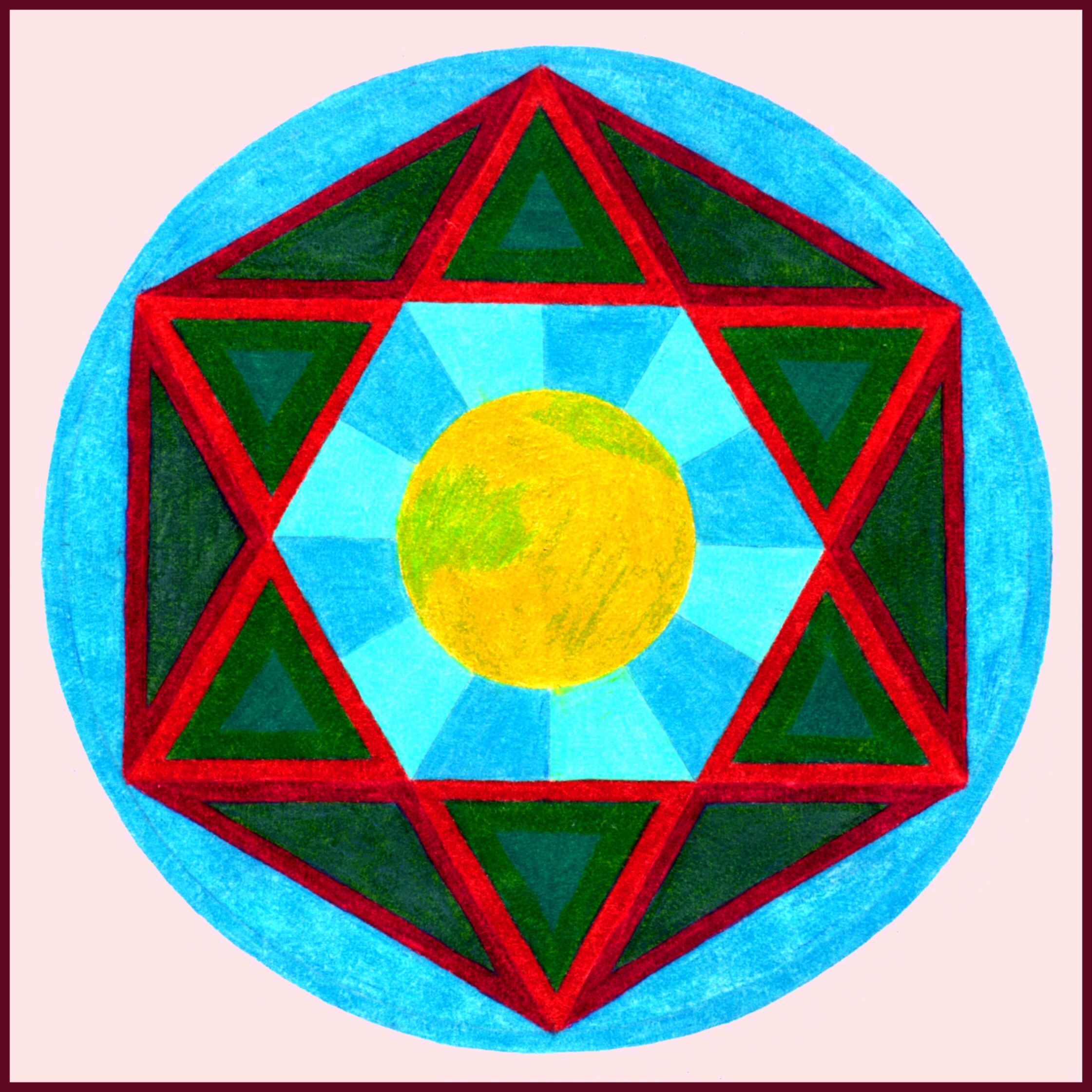
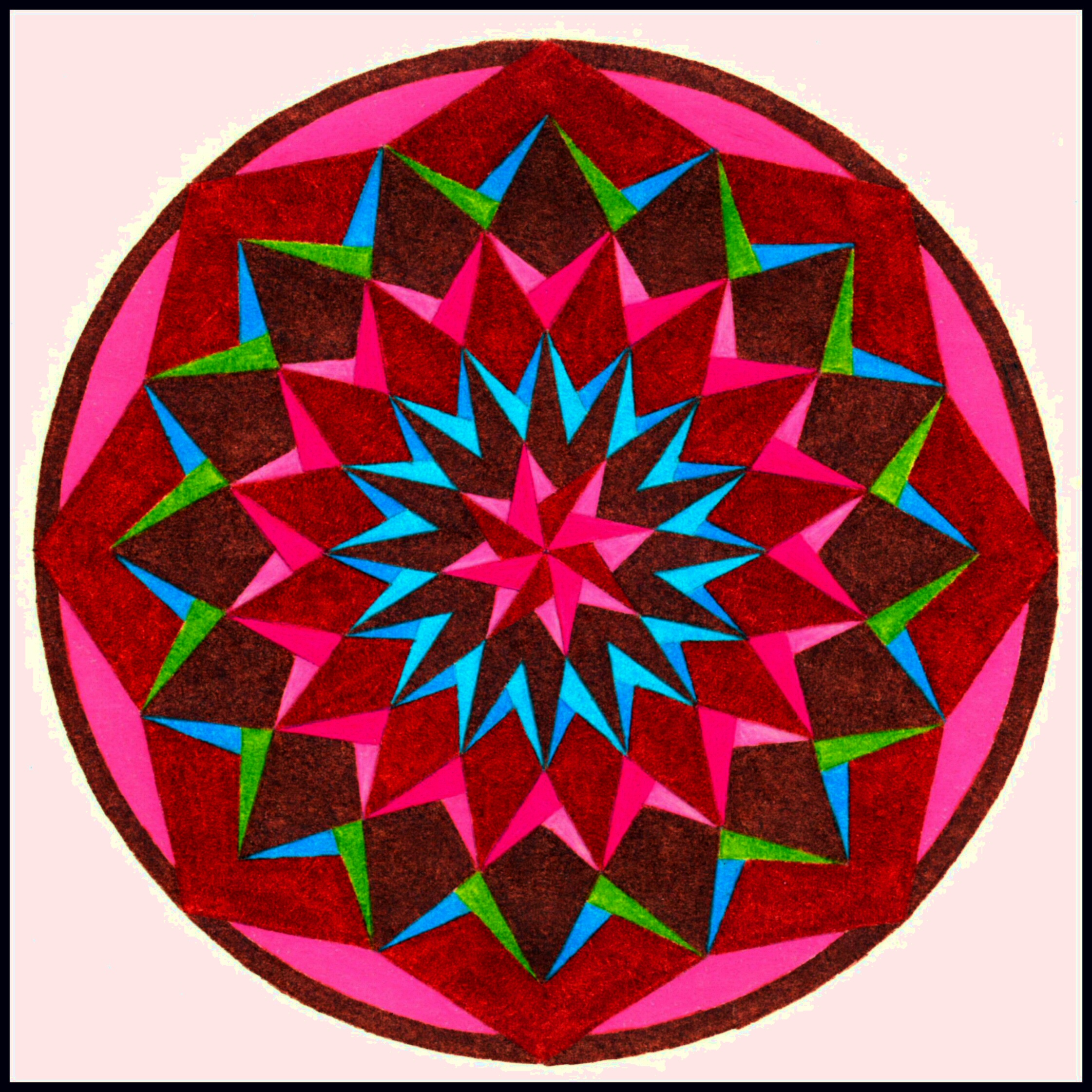
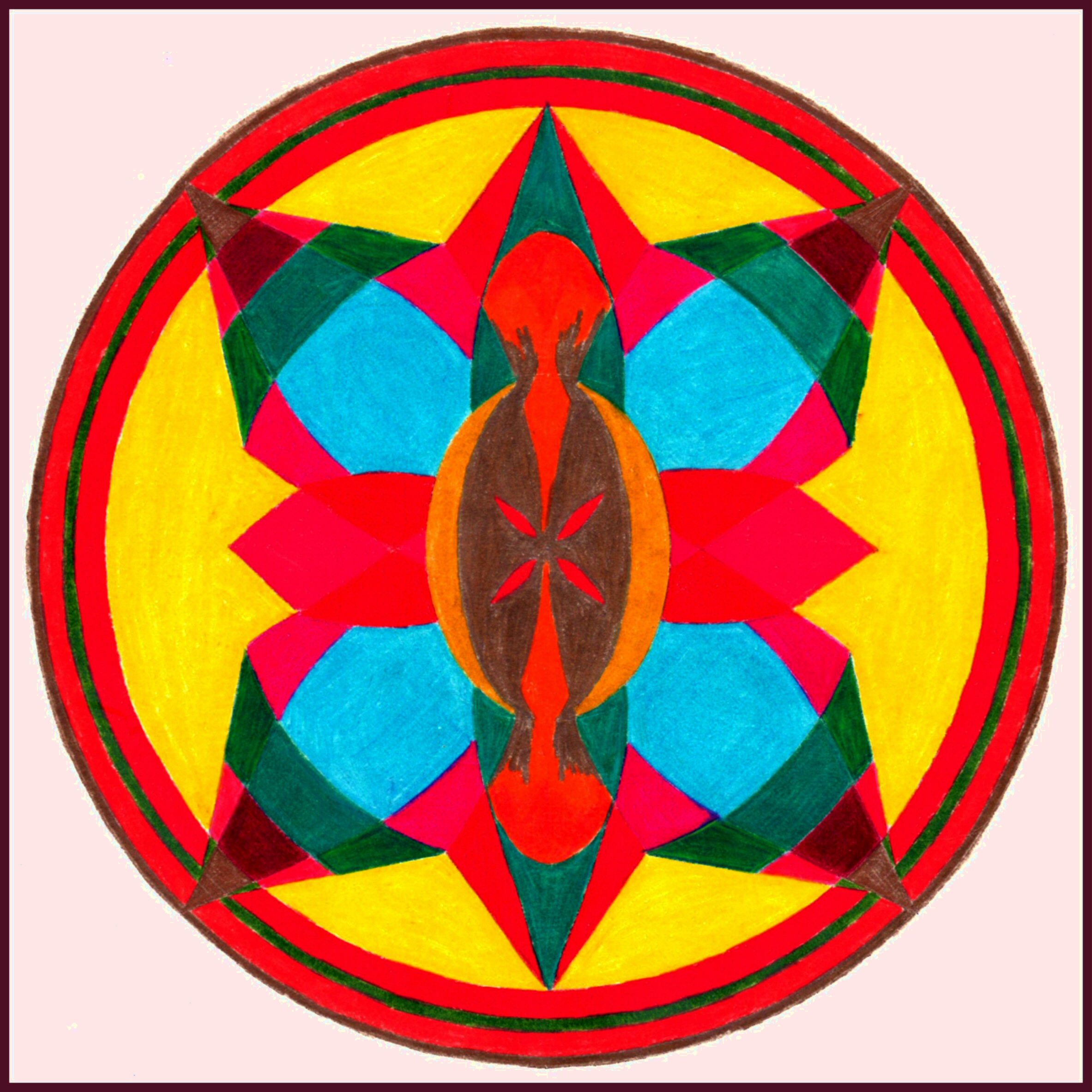
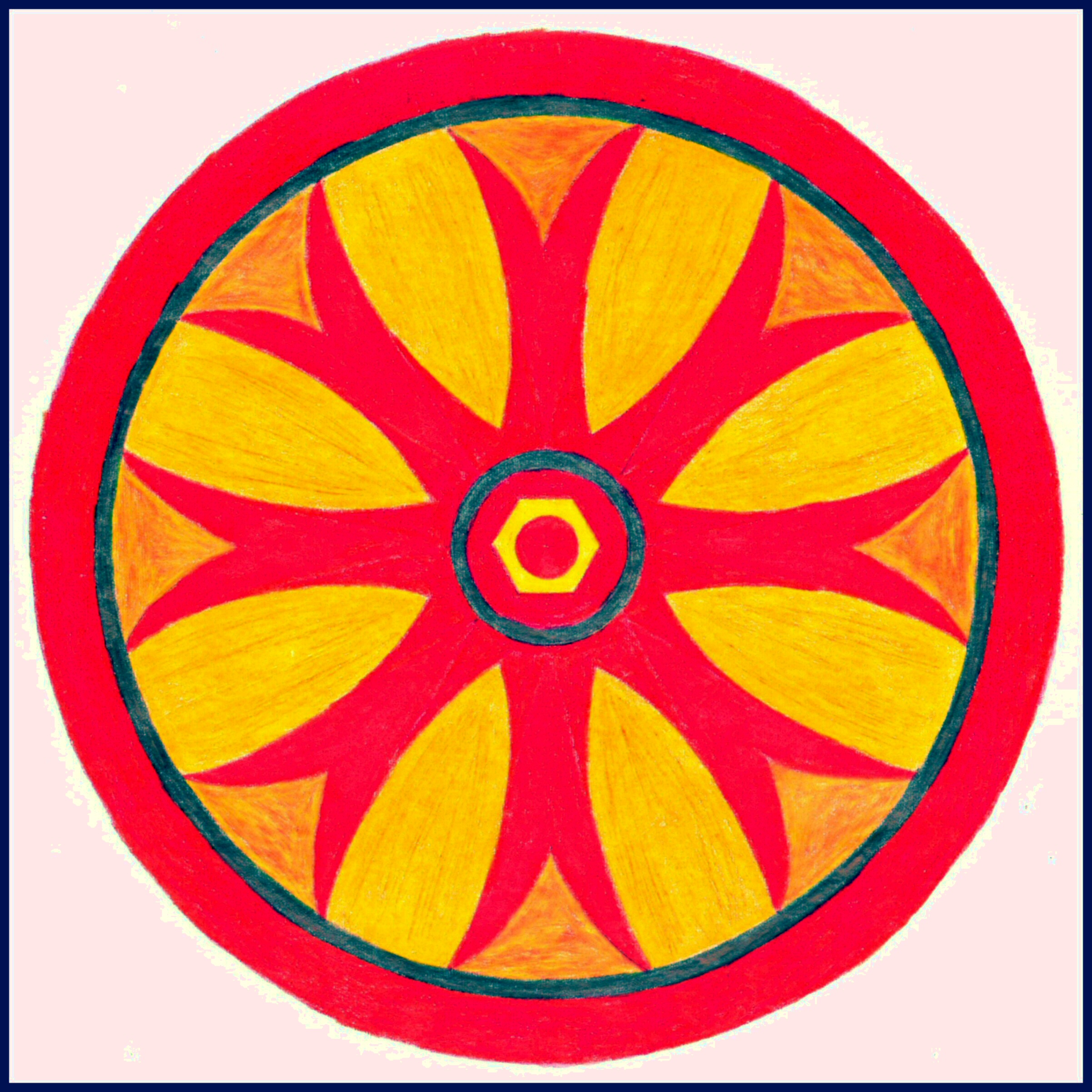
Under the influence of the friend I stayed with right after I moved to San Francisco in 1974, I bought a box of crayons and some colored pencils and jumped into mandala-making. The practice involved creating a new one each day. My first efforts were kind of crude, but the intention was to develop self-awareness rather than to create works of art.

Nevertheless, I was dissatisfied with the slapdash approach that seemed to be necessary in order to produce a new mandala every day. I started being more deliberate and spending more than one day working on each one. Right around then, I met RC (my partner of 30 years), who was a very talented artist. He was working with the mandala form on both small and large scales. He had a stash of drafting tools (among other stashes) and showed me how to use them (the drafting tools). We got into the habit of spending hours sitting together at the dining table, each working on our own drawings.

I made a couple dozen mandalas using markers and colored pencils and developed a heavy Prismacolor habit. We framed a few and hung them on the wall. But i stuck them inside a manila folder a decade or two ago and filed it away in such a safe place I haven’t been able to lay my hands on it for years. In the course of looking for it, however, I unearthed a number of other things I’d forgotten I’d kept or had lost track of. So it’s fitting that last week, while looking for something entirely unrelated, I finally found the manila folder containing the mandalas!

The ones I like best are:

Mandala #1

Mandala #1

Mandala #2

Mandala #2

Mandala #3

Mandala #3

Mandala #4

Mandala #4

Mandala #5

Mandala #5

Mandala #6

Mandala #6

Mandala #7

Mandala #7

Mandala #8

Mandala #8

All of these were created in 1975 and 1976, before the advent of the personal computer and scanner. It was a different time and place, a different way of life. That’s one of the reasons I’m glad to have found them. They remind me of living at a slower pace, of paying attention to things in a different way, and of the companionable evenings RC and I spent together.

I still enjoy coloring mandalas occasionally, but even though I have that stash (of drafting tools) around here somewhere, I haven’t taken the time to draw my own designs in so long it seems unlikely I’ll ever do it again. But that’s OK. That was then, and this is now.

Is there something you once really got into and enjoyed, but that you no longer do–or maybe no longer even think about?

Post Navigation